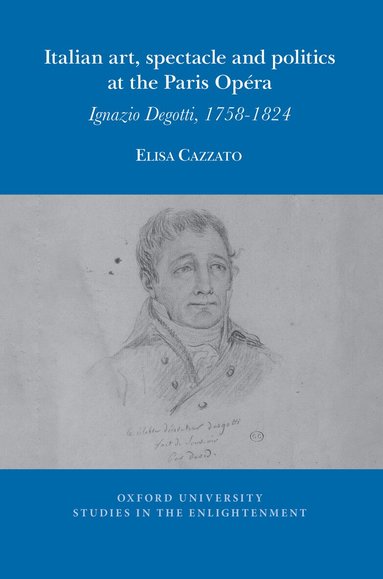
Italian art, spectacle and politics at the Paris Opéra
1 653 krhos Bokus · exkl. frakt
496 kr skillnad mellan billigaste och dyraste butik i lager
Dubbelkollat idag
Jämför 2 butiker
- Bokus, 1 653 kr, frakt enligt butiken. Till butik (öppnas i ny flik)
I lagerFrakt: se butikenDubbelkollad 04:51
1 653 kr
Lägst
- Akademibokhandeln, 2 149 kr, frakt enligt butiken. Till butik (öppnas i ny flik)
I lagerFrakt: se butikenDubbelkollad 04:53
2 149 kr

Priser från butikernas flöden kan ha ändrats: det är priset hos butiken som gäller, så kontrollera det innan du handlar.
Prishistorik
Köp nu eller vänta?
Pris idag
1 653 kr
- Lägst
- 1 652 kr
- Snitt
- 1 752 kr
- Högst
- 2 149 kr
| 2026-10-15 | 2 149 kr · Lägst hos Akademibokhandeln |
|---|---|
| 2026-10-16 | 1 652 kr · Lägst hos Bokus |
| 2026-10-18 | 1 653 kr · Lägst hos Bokus |
Om produkten
Italian art, spectacle and politics at the Paris Opéra
Läs merLäs mindre
Ignazio Degotti (1758-1824) was one of the most influential scenographers working in Paris during the Revolution and Empire. As peintre en chef at the Paris Opéra for more than two decades, he worked at the centre of an institution where visual spectacle became a powerful instrument of artistic innovation and political representation. Drawing on extensive archival research in Italy and France, this book reconstructs Degotti's career and situates his activity within the broader transformation of theatrical culture in the long eighteenth century. It shows how scenography functioned not merely as decoration but as a form of visual dramaturgy capable of structuring space, guiding the spectator's gaze and giving political meaning to the performance.Through case studies ranging from Revolutionary theatre to the grand operatic spectacles under Napoleon, the book reveals collaborative networks behind these performances. It also examines Degotti's artistic relationships with figures such as Jacques-Louis David and the Greuze family, illuminating how sociability, friendship and artistic exchange shaped visual ideas in Napoleonic Paris.By placing scenography at the centre of Enlightenment visual culture, this study offers a new perspective on spectacle, artistic collaboration and the politics of performance while highlighting one of the least studied scenographers of the period.