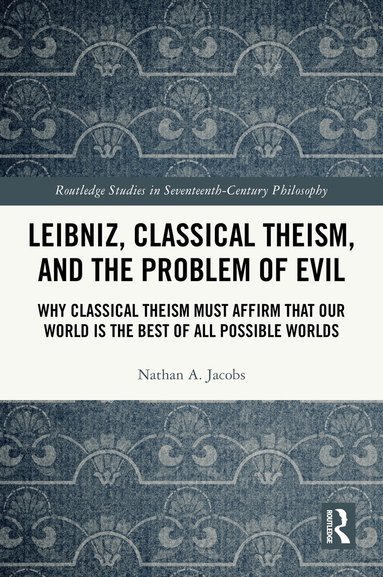
Leibniz, Classical Theism, and the Problem of Evil
- Vikt 0,75 kg
706 krhos Bokus · exkl. frakt
213 kr skillnad mellan billigaste och dyraste butik i lager
Dubbelkollat idag
Jämför 2 butiker
- Bokus, 706 kr, frakt enligt butiken. Till butik (öppnas i ny flik)
I lagerFrakt: se butikenDubbelkollad 19:51
706 kr
Lägst
- Akademibokhandeln, 919 kr, frakt enligt butiken. Till butik (öppnas i ny flik)
I lagerFrakt: se butikenDubbelkollad 19:53
919 kr

Priser från butikernas flöden kan ha ändrats: det är priset hos butiken som gäller, så kontrollera det innan du handlar.
Prishistorik
Köp nu eller vänta?
Just nu kostar produkten 706 kr — 8 kr över det lägsta vi sett på 2 veckor.
Under den tiden har det oftast legat runt 700–710 kr.
Pris idag
706 kr
- Lägst
- 698 kr
- Snitt
- 715 kr
- Högst
- 909 kr
| 2026-09-30 | 909 kr · Lägst hos Akademibokhandeln |
|---|---|
| 2026-10-01 | 698 kr · Lägst hos Bokus |
| 2026-10-04 | 701 kr · Lägst hos Bokus |
| 2026-10-05 | 702 kr · Lägst hos Bokus |
| 2026-10-08 | 709 kr · Lägst hos Bokus |
| 2026-10-10 | 708 kr · Lägst hos Bokus |
| 2026-10-11 | 706 kr · Lägst hos Bokus |
| 2026-10-12 | 704 kr · Lägst hos Bokus |
| 2026-10-16 | 706 kr · Lägst hos Bokus |
Om produkten
Leibniz, Classical Theism, and the Problem of Evil
Läs merLäs mindre
This volume offers a defense of Leibniz's theodicy and his infamous claim that our world is the best of all possible worlds. It considers Leibniz's rationale for "optimism," examines its roots in ancient and medieval thought, and forwards a novel rereading of Leibniz's theory of freedom in light of this background, all of which highlights the very real challenges of evading optimism from within the framework of classical theism.Gottfried Leibniz is known for his "theodicy," or defense of God's Goodness, Wisdom, and Justice despite the realities of evil in our world. This book argues that Leibniz's optimism is inevitable for proponents of classical theism and even for many not-so-classical theists. The author's argument is threefold. First, he demonstrates that Leibniz's theodicy is deeply rooted in the classical theist tradition, pagan and Christian, and shows that the philosopher of Leipzig is merely following these commitments to their logical conclusion, a conclusion that long precedes Leibniz. Second, he offers a novel rereading of Leibniz in the light of his philosophical and theological antecedents, a reading that, if correct, dispels ubiquitous but problematic assumptions about Leibniz's case, specifically those about divine and human freedom. Third, he demonstrates the analytic tether that connects classical theism to Leibniz's conclusion, making his notorious optimism virtually inevitable for proponents of classical theism - and even for not-so-classical theists. This book demonstrates the ways in which Leibniz is relevant to not only classical theists and students of Modern philosophy but also to contemporary philosophers of religion more generally and philosophical theologians who are concerned with the problem of evil.Leibniz, Classical Theism, and the Problem of Evil will appeal to scholars and graduate students interested in Leibniz, philosophy of religion, history of philosophy, philosophical theology, free will, and the problem of evil.
Specifikationer
Fakta
- Vikt
- 0,75 kg
- GTIN
- 09781032739205
Uppgifter från tillverkare och butiker.