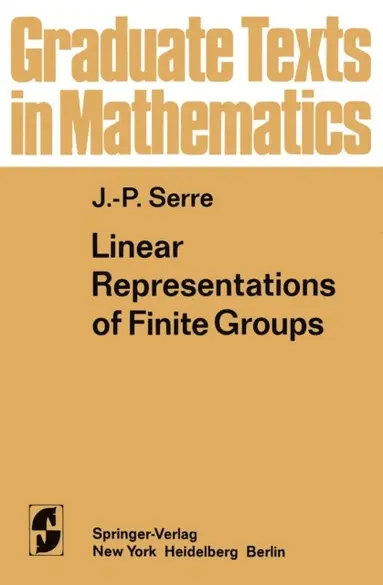
Linear Representations of Finite Groups
Dubbelkollat idag
Jämför 1 butik
- Bokus, 831 kr, frakt enligt butiken. Till butik (öppnas i ny flik)
I lagerFrakt: se butikenDubbelkollad 04:51
831 kr
Lägst

Priser från butikernas flöden kan ha ändrats: det är priset hos butiken som gäller, så kontrollera det innan du handlar.
Prishistorik
Köp nu eller vänta?
Just nu kostar produkten 831 kr — 18 kr över det lägsta vi sett på 1 månad.
Pris idag
831 kr
- Lägst
- 813 kr
- Snitt
- 823 kr
- Högst
- 831 kr
| 2026-09-15 | 813 kr · Lägst hos Bokus |
|---|---|
| 2026-10-05 | 831 kr · Lägst hos Bokus |
Om produkten
Linear Representations of Finite Groups
Läs merLäs mindre
This book consists of three parts, rather different in level and purpose: The first part was originally written for quantum chemists. It describes the correspondence, due to Frobenius, between linear representations and charac ters. This is a fundamental result, of constant use in mathematics as well as in quantum chemistry or physics. I have tried to give proofs as elementary as possible, using only the definition of a group and the rudiments of linear algebra. The examples (Chapter 5) have been chosen from those useful to chemists. The second part is a course given in 1966 to second-year students of I''Ecoie Normale. It completes the first on the following points: (a) degrees of representations and integrality properties of characters (Chapter 6); (b) induced representations, theorems of Artin and Brauer, and applications (Chapters 7-11); (c) rationality questions (Chapters 12 and 13). The methods used are those of linear algebra (in a wider sense than in the first part): group algebras, modules, noncommutative tensor products, semisimple algebras. The third part is an introduction to Brauer theory: passage from characteristic 0 to characteristic p (and conversely). I have freely used the language of abelian categories (projective modules, Grothendieck groups), which is well suited to this sort of question. The principal results are: (a) The fact that the decomposition homomorphism is surjective: all irreducible representations in characteristic p can be lifted "virtually" (i.e., in a suitable Grothendieck group) to characteristic O.