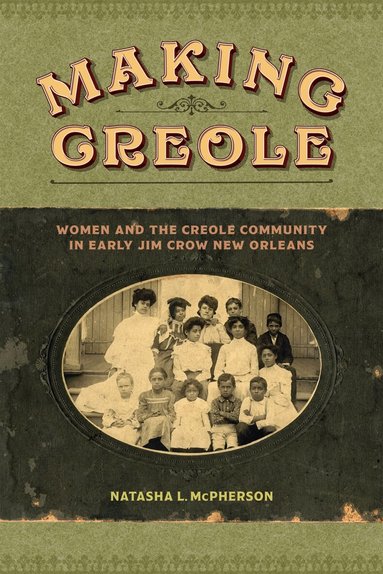
Making Creole
- Vikt 0,45 kg
651 krhos Bokus · exkl. frakt
198 kr skillnad mellan billigaste och dyraste butik i lager
Dubbelkollat idag
Jämför 2 butiker
- Bokus, 651 kr, frakt enligt butiken. Till butik (öppnas i ny flik)
I lagerFrakt: se butikenDubbelkollad 19:51
651 kr
Lägst
- Akademibokhandeln, 849 kr, frakt enligt butiken. Till butik (öppnas i ny flik)
I lagerFrakt: se butikenDubbelkollad 19:53
849 kr

Priser från butikernas flöden kan ha ändrats: det är priset hos butiken som gäller, så kontrollera det innan du handlar.
Prishistorik
Köp nu eller vänta?
Pris idag
651 kr
- Lägst
- 465 kr
- Snitt
- 610 kr
- Högst
- 651 kr
| 2026-10-07 | 609 kr · Lägst hos Akademibokhandeln |
|---|---|
| 2026-10-08 | 465 kr · Lägst hos Bokus |
| 2026-10-10 | 651 kr · Lägst hos Bokus |
Om produkten
Making Creole
Läs merLäs mindre
Between 1880 and 1910, as Jim Crow's legal apparatus transformed Louisiana's complex racial landscape into a stark binary, Creole women fought to preserve their community's distinctive identity through the most ordinary acts of daily life. In their households, they cultivated kinship arrangements that prioritized mutual care over conventional family structures. In workshops and factories, they navigated the degradation of traditional occupations while strategically avoiding associations with Black women's labor. In churches, they deployed Catholic sacraments to formalize social bonds and secure legal protections. In courtrooms, they exploited Louisiana's racial ambiguities to defend their families and assert their claims to elevated status. Through these seemingly mundane spheres of daily existence, Creole women resisted the racial order that sought to collapse all people of African descent into a single category of Blackness.Making Creole: Women and the Creole Community in Early Jim Crow New Orleans examines how Creole women took action against the systematic erosion of their privileges. As Louisiana moved from recognizing the legal status of free people of color to enforcing rigid Jim Crow segregation, Creole women became the primary architects of sociocultural preservation. Before the Civil War, Louisiana law had distinguished all free persons of African descent as legally separate from both enslaved persons and white people, granting them specific rights and privileges based on their "free" status rather than their complexion alone. The end of slavery eliminated this legal distinction. By the early twentieth century, Jim Crow legislation systematically forced all people of African descent into a single racialized category of Blackness, erasing the complex racial hierarchies that had previously structured Louisiana society. In this context, Creole women's labor in managing complex kinship networks, preserving Franco-Catholic traditions, policing community boundaries, and strategically navigating legal institutions constituted essential political work that sustained not just families but an entire ethnic community under siege.Using an innovative "speculative demography" methodology, Natasha L. McPherson analyzes more than nine thousand transcribed records from census data, court documents, and Catholic church registers, including materials from the Sisters of the Holy Family, to reconstruct patterns of Creole women's resistance between 1880 and 1910. Making Creole moves beyond traditional narratives of political organizing to illuminate how women's everyday practices became mechanisms of ethnic identity formation and cultural survival, revealing resistance from the intimate spaces where it actually occurred.
Specifikationer
Fakta
- Vikt
- 0,45 kg
- GTIN
- 09780807186763
Uppgifter från tillverkare och butiker.