Managing the Union Army
- Vikt 0,82 kg
Dubbelkollat idag
Jämför 2 butiker
- Akademibokhandeln, 819 kr, frakt enligt butiken. Till butik (öppnas i ny flik)
I lagerFrakt: se butikenDubbelkollad 16:53
819 kr
Lägst
- Bokus, 632 kr, frakt enligt butiken. Till butik (öppnas i ny flik)
Slut i lagerFrakt: se butikenDubbelkollad 16:51
632 kr

Priser från butikernas flöden kan ha ändrats: det är priset hos butiken som gäller, så kontrollera det innan du handlar.
Prishistorik
Köp nu eller vänta?
Pris idag
819 kr
- Lägst
- 632 kr
- Snitt
- 726 kr
- Högst
- 819 kr
| 2026-10-14 | 819 kr · Lägst hos Akademibokhandeln |
|---|---|
| 2026-10-15 | 632 kr · Lägst hos Bokus |
| 2026-10-17 | 819 kr · Lägst hos Akademibokhandeln |
Om produkten
Managing the Union Army
Läs merLäs mindre
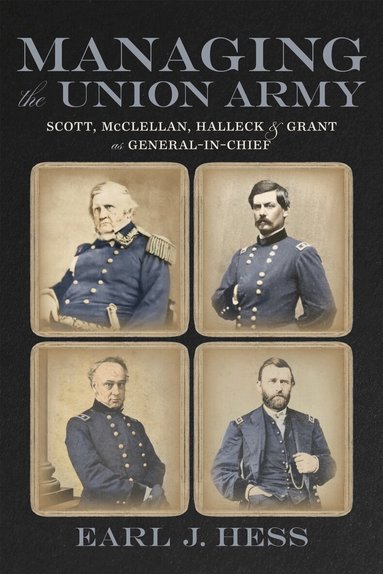
The general-in-chief did not command the million-man Union army that fought in the Civil War, as most historians have assumed; rather, he was a member of a management team that included the president and the secretary of war. The president, as commander-in-chief, created the position by appointing an officer to it, and he could dismiss that officer at any time and choose not to appoint another. The general-in-chief had to cooperate closely with the president and the secretary of war to ensure the team functioned effectively. In Managing the Union Army, renowned Civil War historian Earl J. Hess upends our understanding of the general-in-chief, his role in the Union military system, and his influence on the conflict's outcome. Hess reinterprets the accomplishments and failures of the four men who held the position, evaluating Winfield Scott, George B. McClellan, Henry W. Halleck, and Ulysses S. Grant in ways that might surprise many students of Civil War military history. The Union general-in-chief could take on four major responsibilities. The first was to serve as a military advisor to the president and the secretary of war. The second was to develop policies to govern the huge Union army. The third was to recommend officers to command corps, field armies, and military departments. The fourth was to actually command a portion of the army in field operations, a role that Grant alone fulfilled. Hess shows how the performance of the four men varied greatly across the three other tasks. He also details Grant's unique achievement as a field commander-ending the war, which none of the other Union generals-in-chief were able to do. Hess illuminates how personality traits helped or hindered the generals-in-chief during the war. McClellan's deeply flawed personality contributed to his failure in fulfilling the duties of the position. Grant's strongly positive personality and will-do attitude, by contrast, helped him to succeed more fully in the role than any of his predecessors. Hess also offers a much more positive evaluation of Halleck than is typical of the scholarly literature on Civil War commanders. Halleck was not only a successful general-in-chief but also fundamentally supported Grant during the last year of the conflict by serving as chief of staff of the U.S. Army, a fourth member of the management team. From an elderly though distinguished officer like Scott, to Grant, the most effective general of the Civil War, the office of general-in-chief evolved into the crucial military position in the Federal war effort. Hess's study, through a close examination of administrative history, offers a dramatically new way of understanding how the Union army worked in the Civil War.
Specifikationer
Fakta
- Vikt
- 0,82 kg
- GTIN
- 09780807185230
Uppgifter från tillverkare och butiker.