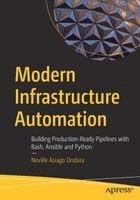
Modern Infrastructure Automation
- Vikt 0,34 kg
780 krhos Bokus · exkl. frakt
239 kr skillnad mellan billigaste och dyraste butik i lager
Dubbelkollat idag
Jämför 2 butiker
- Bokus, 780 kr, frakt enligt butiken. Till butik (öppnas i ny flik)
I lagerFrakt: se butikenDubbelkollad 19:51
780 kr
Lägst
- Akademibokhandeln, 1 019 kr, frakt enligt butiken. Till butik (öppnas i ny flik)
I lagerFrakt: se butikenDubbelkollad 19:53
1 019 kr

Priser från butikernas flöden kan ha ändrats: det är priset hos butiken som gäller, så kontrollera det innan du handlar.
Prishistorik
Köp nu eller vänta?
Pris idag
780 kr
- Lägst
- 780 kr
- Snitt
- 929 kr
- Högst
- 1 219 kr
| 2026-10-13 | 1 219 kr · Lägst hos Akademibokhandeln |
|---|---|
| 2026-10-14 | 938 kr · Lägst hos Bokus |
| 2026-10-15 | 780 kr · Lägst hos Bokus |
Om produkten
Infrastructure automation is rarely clean or uniform
Läs merLäs mindre
In real production environments, teams inherit legacy Bash scripts, introduce Python to manage APIs and complex logic, and eventually adopt configuration management tools like Ansible to enforce consistency. While each of these tools is powerful on its own, combining them without a clear strategy often leads to fragile automation, duplicated logic, and systems that are difficult to debug or maintain. This book addresses this reality head-on. Instead of teaching Bash, Python, and Ansible in isolation, this book presents a hybrid, scenario-driven approach to automation design. It focuses on decision-making, when to use each tool, how to integrate them cleanly, and how to evolve automation as systems grow in complexity.Modern Infrastructure Automation introduces the concept of automation "playbooks": practical, reusable patterns for solving real operational problems such as deployments, health checks, incident response, and recovery workflows. Each playbook demonstrates how Bash can serve as a fast, ubiquitous glue logic; how Python can handle structured data, APIs, and complex control flow; and how Ansible can enforce desired state and convergence across systems.Rather than present best-case scenarios, the examples reflect messy, real-world conditions: partial failures, legacy scripts and operational constraints. Readers will learn how to recognize when a Bash script has reached its limits, how to refactor logic into Python without rewriting everything, and how to introduce Ansible without over-engineering simple tasks. By the end of the book, you will be able to design automation systems that are modular, understandable, and production-ready; automation that survives real operational pressure rather than collapsing under it.You Will Learn:How to choose the right automation tool (Bash, Python, or Ansible) based on task complexity and lifecycleHow to design hybrid automation workflows that integrate multiple tools cleanlyWhen and how to refactor fragile scripts into maintainable, modular systemsPractical patterns for deployment, monitoring, and incident-response automationHow to build automation that remains understandable and maintainable by teams over timeThis Book is For:This book is written for system administrators, DevOps engineers, site reliability engineers (SREs), and infrastructure-focused software engineers who work with Linux-based systems.Readers should have familiarity with Linux command-line usage and at least introductory exposure to scripting or automation tools.
Specifikationer
Fakta
- Vikt
- 0,34 kg
- GTIN
- 09798868829703
Uppgifter från tillverkare och butiker.