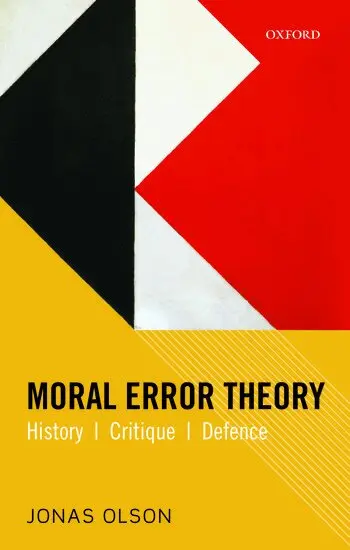
Moral Error Theory
- Vikt 0,29 kg
549 krhos Bokus · exkl. frakt
160 kr skillnad mellan billigaste och dyraste butik i lager
Dubbelkollade priser
Jämför 3 butiker
- Bokus, 549 kr, frakt enligt butiken. Till butik (öppnas i ny flik)
I lagerFrakt: se butikenDubbelkollad 07:51
549 kr
Lägst
- Akademibokhandeln, 709 kr, frakt enligt butiken. Till butik (öppnas i ny flik)
I lagerFrakt: se butikenDubbelkollad 07:53
709 kr
- Adlibris, 537 kr, frakt enligt butiken. Till butik (öppnas i ny flik)
Slut i lagerFrakt: se butikenDubbelkollad 27 okt. 09:10
537 kr


Priser från butikernas flöden kan ha ändrats: det är priset hos butiken som gäller, så kontrollera det innan du handlar.
Prishistorik
Köp nu eller vänta?
Just nu kostar produkten 549 kr — 18 kr över det lägsta vi sett på 1 månad.
Under den tiden har det oftast legat runt 540 kr.
Pris idag
549 kr
- Lägst
- 531 kr
- Snitt
- 538 kr
- Högst
- 549 kr
| 2026-09-15 | 531 kr · Lägst hos Bokus |
|---|---|
| 2026-09-18 | 537 kr · Lägst hos Bokus |
| 2026-10-27 | 549 kr · Lägst hos Bokus |
Om produkten
Moral Error Theory
Läs merLäs mindre
Jonas Olson presents a critical survey of moral error theory, the view that there are no moral facts and so all moral claims are false. In Part I (History), he explores the historical context of the debate, and discusses the moral error theories of David Hume and of some more or less influential twentieth century philosophers, including Axel Hägerström, Bertrand Russell, Ludwig Wittgenstein, and Richard Robinson. He argues that the early cases for moral error theory are suggestive but that they would have been stronger had they included something like J. L. Mackie's arguments that moral properties and facts are metaphysically queer. Part II (Critique) focuses on these arguments. Olson identifies four queerness arguments, concerning supervenience, knowledge, motivation, and irreducible normativity, and goes on to establish that while the first three are not compelling, the fourth has considerable force, especially when combined with debunking explanations of why we tend to believe that there are moral properties and facts when in fact there are none. One conclusion of Part II is that a plausible error theory takes the form of an error theory about irreducible normativity. In Part III (Defence), Olson considers challenges according to which that kind of error theory has problematic ramifications regarding hypothetical reasons, epistemic reasons, and deliberation. He ends his discussion with a consideration of the implications of moral error theory for ordinary moral thought and talk, and for normative theorizing.
Specifikationer
Fakta
- Vikt
- 0,29 kg
- GTIN
- 09780198769972
Uppgifter från tillverkare och butiker.