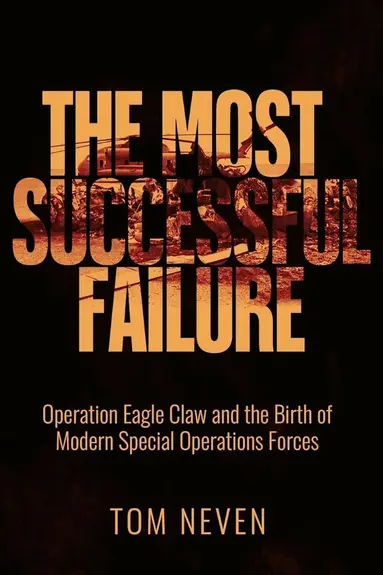
Most Successful Failure: Operation Eagle Claw and the Birth of Modern Special Operations Forces
Dubbelkollat idag
Jämför 2 butiker
- Bokus, 412 kr, frakt enligt butiken. Till butik (öppnas i ny flik)
Slut i lagerFrakt: se butikenDubbelkollad 15:51
412 kr
- Akademibokhandeln, 539 kr, frakt enligt butiken. Till butik (öppnas i ny flik)
Slut i lagerFrakt: se butikenDubbelkollad 15:53
539 kr

Priser från butikernas flöden kan ha ändrats: det är priset hos butiken som gäller, så kontrollera det innan du handlar.
Prishistorik
Köp nu eller vänta?
- Lägst
- 399 kr
- Snitt
- 420 kr
- Högst
- 539 kr
| 2026-09-15 | 399 kr · Lägst hos Bokus |
|---|---|
| 2026-09-21 | 403 kr · Lägst hos Bokus |
| 2026-09-26 | 417 kr · Lägst hos Bokus |
| 2026-10-02 | 408 kr · Lägst hos Bokus |
| 2026-10-10 | 412 kr · Lägst hos Bokus |
| 2026-10-23 | 430 kr · Lägst hos Bokus |
| 2026-10-28 | 539 kr · Lägst hos Akademibokhandeln |
| 2026-10-31 | Ingen butik hade produkten i lager |
Om produkten
On November 4, 1979, Iranian militants seized the U.S
Läs merLäs mindre
embassy in Tehran and took the entire diplomatic staff hostage. The United States was caught flat-footed by this act of terrorism, and while President Jimmy Carter initially pursued a diplomatic solution to the crisis, he authorized the military to begin planning a rescue mission. They faced a daunting task: moving an assault force thousands of miles into hostile territory undetected, rescuing the hostages, and getting out again, all with limited equipment and intelligence. A mere 10 years earlier, the U.S. had carried out a special operations raid deep into the heart of North Vietnam to free American prisoners of war in the Son Tay POW camp, but that capability had withered in the intervening years to become almost nonexistent. Still, planners slowly assembled a team and formulated a plan to insert a raiding force directly into the U.S. embassy compound in Tehran and get the hostages out. The plan, which stretched U.S. military capabilities to the breaking point, was so intricate, with so many potential failure points, that many doubted it would ever be launched. But launch they did on April 24, 1980, on a mission dubbed Eagle Claw. It ended in disaster when two aircraft collided in the dark in the confusion of a hasty withdrawal in the middle of the Iranian desert. Eight American servicemen died.It was a humiliating failure, but it was not an ultimate defeat. The lessons learned from that debacle in the desert would be used over a period of less than 20 years to craft a special operations capability second to none and would culminate in a near-perfect raid in May 2011 to kill the architect of the 9/11 terrorist attacks, Osama bin Laden. Years later, one Eagle Claw participant would describe that terrible day in April 1980 as "the most successful failure."Much has been written about this operation, but this new, comprehensive account incorporates information from thousands of recently declassified documents that provide additional detail and never-before-told stories. This book also features more than 35 personal interviews and first-person accounts from participants of the mission as well as archival material.