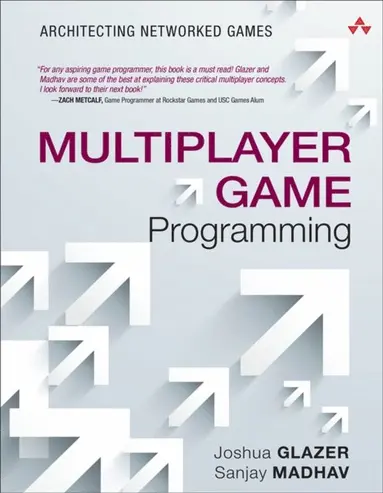
Multiplayer Game Programming
Dubbelkollat idag
Jämför 1 butik
- Bokus, 677 kr, frakt enligt butiken. Till butik (öppnas i ny flik)
I lagerFrakt: se butikenDubbelkollad 01:51
677 kr
Lägst

Priser från butikernas flöden kan ha ändrats: det är priset hos butiken som gäller, så kontrollera det innan du handlar.
Prishistorik
Köp nu eller vänta?
Just nu kostar produkten 677 kr — 15 kr över det lägsta vi sett på 1 månad.
Pris idag
677 kr
- Lägst
- 662 kr
- Snitt
- 669 kr
- Högst
- 677 kr
| 2026-09-15 | 662 kr · Lägst hos Bokus |
|---|---|
| 2026-10-10 | 677 kr · Lägst hos Bokus |
Om produkten
Multiplayer Game Programming
Läs merLäs mindre
The Practical Guide to Building Reliable Networked Multiplayer Games Networked multiplayer games are a multibillion dollar business: some games now attract tens of millions of players. In this practical, code-rich guide, Joshua Glazer and Sanjay Madhav guide you through every aspect of engineering them. Drawing on their immense experience as both game developers and instructors, the authors lead you through building a robust multiplayer architecture, and creating every engine-level system. Youâ€TMll learn through in-depth working code examples for two complete games: an action game and a real time strategy (RTS) game. First, Madhav and Glazer review the essentials of networking and network programming from the standpoint of game developers. Next, they walk through managing game data transmission, updating game objects across the network, and organizing the devices that join your game. Youâ€TMll learn how to ensure reliable performance despite the Internetâ€TMs inherent inconsistencies, and how to design game code for maximum security and scalability. The authors conclude by addressing two increasingly crucial issues: incorporating gamer services and hosting your games in the cloud. This guideâ€TMs content has been extensively tested through the authorsâ€TM multiplayer game programming courses at USC. It is equally valuable both to students and to working game programmers moving into networked games. Coverage includes How games have evolved to meet the challenges of networked environments Using Internet communication protocols and standards in game development Working with Berkeley Socket, the most widely used networking construct in multiplayer gaming Formatting game data for efficient Internet transmission Synchronizing states so all players share the same world Organizing networking topologies for large-scale games Overcoming latency and jitter problems that cause delays or lost data Scaling games without compromising performance Combating security vulnerabilities and software cheats Leveraging the networking functionality of the popular Unreal 4 and Unity game engines Integrating gamer services such as matchmaking, achievements, and leaderboards Running game servers in the cloud About the Website C++ source code for all examples is available at github.com/MultiplayerBook. Instructors will also find a full set of PowerPoint slides and a sample syllabus.