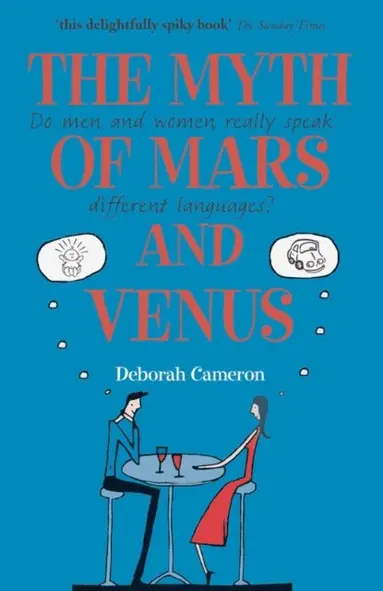
Myth of Mars and Venus
Dubbelkollat idag
Jämför 1 butik
- Bokus, 147 kr, frakt enligt butiken. Till butik (öppnas i ny flik)
I lagerFrakt: se butikenDubbelkollad 05:51
147 kr
Lägst

Priser från butikernas flöden kan ha ändrats: det är priset hos butiken som gäller, så kontrollera det innan du handlar.
Prishistorik
Köp nu eller vänta?
Just nu kostar produkten 147 kr — 43 kr över det lägsta vi sett på 1 månad.
Under den tiden har det oftast legat runt 130–160 kr.
Pris idag
147 kr
- Lägst
- 104 kr
- Snitt
- 142 kr
- Högst
- 161 kr
| 2026-09-15 | 159 kr · Lägst hos Bokus |
|---|---|
| 2026-09-21 | 161 kr · Lägst hos Bokus |
| 2026-09-25 | 144 kr · Lägst hos Bokus |
| 2026-09-28 | 161 kr · Lägst hos Bokus |
| 2026-10-01 | 104 kr · Lägst hos Bokus |
| 2026-10-11 | 129 kr · Lägst hos Bokus |
| 2026-10-13 | 147 kr · Lägst hos Bokus |
| 2026-10-27 | 161 kr · Lägst hos Bokus |
| 2026-10-31 | 147 kr · Lägst hos Bokus |
Om produkten
Myth of Mars and Venus
Läs merLäs mindre
Popular assumptions about gender and communication - famously summed up in the title of the massively influential 1992 bestseller Men Are From Mars, Women Are From Venus - can have unforeseen but far-reaching consequences in many spheres of life, from attitudes to the phenomenon of ''date-rape'' to expectations of achievement at school, and potential discrimination in the work-place. In this wide-ranging and thoroughly readable book, Deborah Cameron, Rupert Murdoch Professor of Language and Communication at Oxford University and author of a number of leading texts in the field of language and gender studies, draws on over 30 years of scientific research to explain what we really know and to demonstrate how this is often very different from the accounts we are familiar with from recent popular writing. Ambitious in scope and exceptionally accessible, The Myth of Mars and Venus tells it like it is: widely accepted attitudes from the past and from other cultures are at heart related to assumptions about language and the place of men and women in society; and there is as much similarity and variation within each gender as between men and women, often associated with social roles and relationships. The author goes on to consider the influence of Darwinian theories of natural selection and the notion that girls and boys are socialized during childhood into different ways of using language, before addressing problems of ''miscommunication'' surrounding, for example, sex and consent to sex, and women''s relative lack of success in work and politics. Arguing that what linguistic differences there are between men and women are driven by the need to construct and project personal meaning and identity, Cameron concludes that we have an urgent need to think about gender in more complex ways than the prevailing myths and stereotypes allow.A compelling and insightful read for anyone with an interest in communication, language, and the sexes.