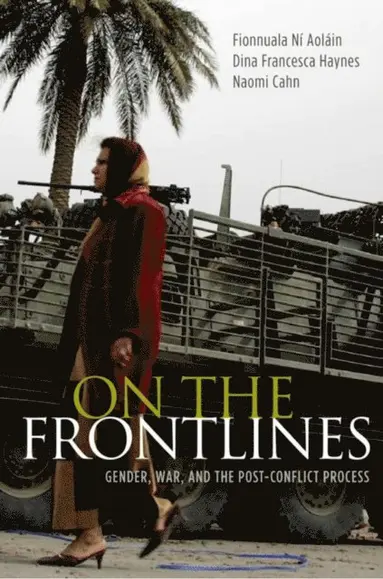
On the Frontlines
Dubbelkollat idag
Jämför 1 butik
- Bokus, 414 kr, frakt enligt butiken. Till butik (öppnas i ny flik)
I lagerFrakt: se butikenDubbelkollad 02:51
414 kr
Lägst

Priser från butikernas flöden kan ha ändrats: det är priset hos butiken som gäller, så kontrollera det innan du handlar.
Prishistorik
Köp nu eller vänta?
Just nu kostar produkten 414 kr — 205 kr över det lägsta vi sett på 1 månad.
Under den tiden har det oftast legat runt 210–410 kr.
Pris idag
414 kr
- Lägst
- 209 kr
- Snitt
- 350 kr
- Högst
- 414 kr
| 2026-09-15 | 390 kr · Lägst hos Bokus |
|---|---|
| 2026-09-29 | 209 kr · Lägst hos Bokus |
| 2026-10-12 | 414 kr · Lägst hos Bokus |
Om produkten
On the Frontlines
Läs merLäs mindre
Gender oppression has been a feature of war and conflict throughout human history, yet until fairly recently, little attention was devoted to addressing the consequences of violence and discrimination experienced by women in post-conflict states. Thankfully, that is changing. Today, in a variety of post-conflict settings--the former Yugoslavia, Afghanistan, Colombia, Northern Ireland --international advocates for women''s rights have focused bringing issues of sexual violence, discrimination and exclusion into peace-making processes. In On the Frontlines, Fionnuala Nà Aoláin, Dina Francesca Haynes, and Naomi Cahn consider such policies in a range of cases and assess the extent to which they have had success in improving women''s lives. They argue that there has been too little success, and that this is in part a product of a focus on schematic policies like straightforward political incorporation rather than a broader and deeper attempt to alter the cultures and societies that are at the root of much of the violence and exclusions experienced by women. They contend that this broader approach would not just benefit women, however. Gender mainstreaming and increased gender equality has a direct correlation with state stability and functions to preclude further conflict. If we are to have any success in stabilizing failing states, gender needs to move to fore of our efforts. With this in mind, they examine the efforts of transnational organizations, states and civil society in multiple jurisdictions to place gender at the forefront of all post-conflict processes. They offer concrete analysis and practical solutions to ensuring gender centrality in all aspects of peace making and peace enforcement.