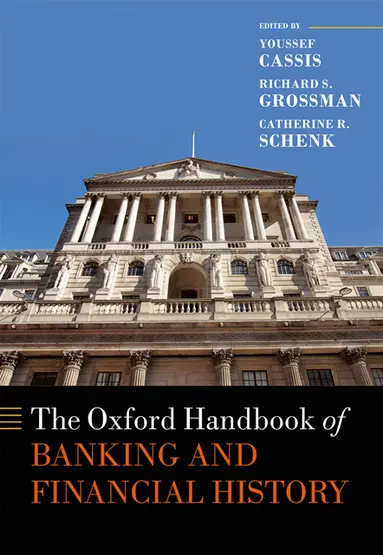
Oxford Handbook of Banking and Financial History
Dubbelkollat idag
Jämför 1 butik
- Bokus, 537 kr, frakt enligt butiken. Till butik (öppnas i ny flik)
I lagerFrakt: se butikenDubbelkollad 02:51
537 kr
Lägst

Priser från butikernas flöden kan ha ändrats: det är priset hos butiken som gäller, så kontrollera det innan du handlar.
Prishistorik
Köp nu eller vänta?
Just nu kostar produkten 537 kr — 56 kr över det lägsta vi sett på 1 månad.
Under den tiden har det oftast legat runt 510–530 kr.
Pris idag
537 kr
- Lägst
- 481 kr
- Snitt
- 516 kr
- Högst
- 537 kr
| 2026-09-15 | 530 kr · Lägst hos Bokus |
|---|---|
| 2026-09-19 | 499 kr · Lägst hos Bokus |
| 2026-09-21 | 537 kr · Lägst hos Bokus |
| 2026-09-26 | 499 kr · Lägst hos Bokus |
| 2026-09-29 | 481 kr · Lägst hos Bokus |
| 2026-10-03 | 517 kr · Lägst hos Bokus |
| 2026-10-22 | 510 kr · Lägst hos Bokus |
| 2026-10-28 | 537 kr · Lägst hos Bokus |
Om produkten
Oxford Handbook of Banking and Financial History
Läs merLäs mindre
The financial crisis of 2008 aroused widespread interest in banking and financial history among policy makers, academics, journalists, and even bankers, in addition to the wider public. References in the press to the term ''Great Depression'' spiked after the failure of Lehman Brothers in November 2008, with similar surges in references to ''economic history'' at various times during the financial turbulence. In an attempt to better understand the magnitude of the shock, there was a demand for historical parallels. How severe was the financial crash? Was it, in fact, the most severe financial crisis since the Great Depression? Were its causes unique or part of a well-known historical pattern? And have financial crises always led to severe depressions?Historical reflection on the recent financial crises and the long-term development of the financial system go hand in hand. This volume provides the material for such a reflection by presenting the state of the art in banking and financial history. Nineteen highly regarded experts present chapters on the economic and financial side of banking and financial activities, primarily though not solely in advanced economies, in a long-term comparative perspective. In addition to paying attention to general issues, not least those related to theoretical and methodological aspects of the discipline, the volume approaches the banking and financial world from four distinct but interrelated angles: financial institutions, financial markets, financial regulation, and financial crises.