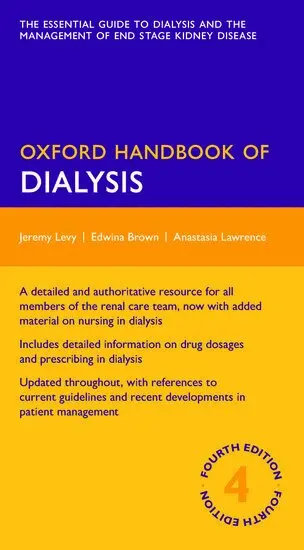
Oxford Handbook of Dialysis
Dubbelkollade priser
Jämför 2 butiker
- Bokus, 605 kr, frakt enligt butiken. Till butik (öppnas i ny flik)
I lagerFrakt: se butikenDubbelkollad 08:51
605 kr
Lägst
- Adlibris, 659 kr, frakt enligt butiken. Till butik (öppnas i ny flik)
Slut i lagerFrakt: se butikenDubbelkollad 27 okt. 09:10
659 kr


Priser från butikernas flöden kan ha ändrats: det är priset hos butiken som gäller, så kontrollera det innan du handlar.
Prishistorik
Köp nu eller vänta?
Just nu kostar produkten 605 kr — 13 kr över det lägsta vi sett på 1 månad.
Pris idag
605 kr
- Lägst
- 592 kr
- Snitt
- 597 kr
- Högst
- 605 kr
| 2026-09-15 | 592 kr · Lägst hos Bokus |
|---|---|
| 2026-10-13 | 605 kr · Lägst hos Bokus |
Om produkten
Oxford Handbook of Dialysis
Läs merLäs mindre
The Oxford Handbook of Dialysis is a comprehensive and practical guide to all aspects of dialysis, the management of patients with end stage kidney disease, and all its complications. The fourth edition has been completely updated, and covers all aspects of dialysis from haemodialysis techniques and haemodiafitration, to the medical, nursing and psychosocial aspects of managing patients with end stage kidney failure. Renal transplantation, plasma exchange, palliative care, and drug dosing are discussed, along with end of life care, and complications of chronic kdney disease. This handbook is packed with practical guidance and management, presented in a compact and easy to use format. The Oxford Handbook of Dialysis is aimed at all health care professionals dealing with dialysis patients from nephrologists to dieticians, as well as pharmacists, nurses, and surgeons. There are specific chapters on nursing patients on haemodialysis and peritoneal dialysis, and detailed nutrition and drug prescribing chapters. The fourth edition includes new sections on renal replacement therapies in acute kidney injury, home dialysis, new peritoneal dialysis fluids, new drugs including new epoietins and phosphate binders, updated sections on nocturnal dialysis, dialysis monitoring, encapsulating peritoneal sclerosis, and sleep disorders. Easy to read, practical, and focussed, this handbook should have a home in every renal unit, dialysis centre, renal ward, and be close to hand for every nephrologist, renal trainee, or renal nurse.