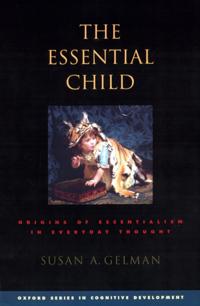
Oxford Series in Cognitive Development
Dubbelkollade priser
Jämför 1 butik
- Adlibris, 638 kr, frakt enligt butiken. Till butik (öppnas i ny flik)
Slut i lagerFrakt: se butikenDubbelkollad 27 okt. 09:10
638 kr

Priser från butikernas flöden kan ha ändrats: det är priset hos butiken som gäller, så kontrollera det innan du handlar.
Prishistorik
Köp nu eller vänta?
- Lägst
- 610 kr
- Snitt
- 626 kr
- Högst
- 638 kr
| 2026-09-15 | 610 kr · Lägst hos Adlibris |
|---|---|
| 2026-09-17 | 618 kr · Lägst hos Adlibris |
| 2026-10-03 | Ingen butik hade produkten i lager |
| 2026-10-08 | 638 kr · Lägst hos Adlibris |
| 2026-10-21 | Ingen butik hade produkten i lager |
Om produkten
Oxford Series in Cognitive Development
Läs merLäs mindre
Essentialism is the idea that certain categories, such as "dog," "man," or "intelligence," have an underlying reality or true nature that gives objects their identity. Where does this idea come from? In this book, Susan Gelman argues that essentialism is an early cognitive bias. Young children''s concepts reflect a deep commitment to essentialism, and this commitment leads children to look beyond the obvious in many converging ways: when learning words, generalizing knowledge to new category members, reasoning about the insides of things, contemplating the role of nature versus nurture, and constructing causal explanations. Gelman argues against the standard view of children as concrete or focused on the obvious, instead claiming that children have an early, powerful tendency to search for hidden, non-obvious features of things. She also attacks claims that children build up their knowledge of the world based on simple, associative learning strategies, arguing that children''s