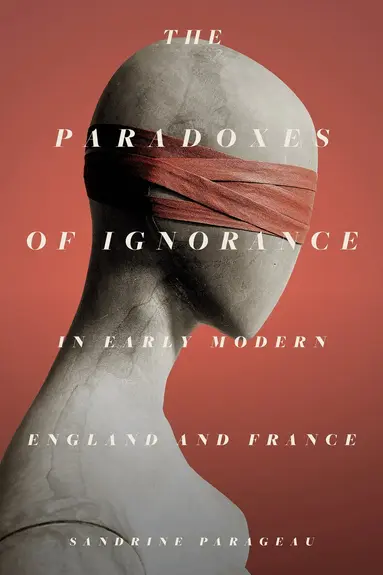
Paradoxes of Ignorance in Early Modern England and France
- Vikt 0,39 kg
327 kr328 kr−0% senaste veckanhos Bokus · exkl. frakt
Jämfört med det lägsta pris vi sett de 30 dagarna före sänkningen.
102 kr skillnad mellan billigaste och dyraste butik i lager
Dubbelkollat idag
Jämför 2 butiker
- Bokus, 327 kr, frakt enligt butiken. Till butik (öppnas i ny flik)
I lagerFrakt: se butikenDubbelkollad 13:51
327 kr
Lägst
- Akademibokhandeln, 429 kr, frakt enligt butiken. Till butik (öppnas i ny flik)
I lagerFrakt: se butikenDubbelkollad 13:53
429 kr

Priser från butikernas flöden kan ha ändrats: det är priset hos butiken som gäller, så kontrollera det innan du handlar.
Prishistorik
Köp nu eller vänta?
Just nu kostar produkten 327 kr — 1 kr över det lägsta vi sett på 1 månad.
Under den tiden har det oftast legat runt 330 kr.
Pris idag
327 kr
- Lägst
- 326 kr
- Snitt
- 328 kr
- Högst
- 331 kr
| 2026-09-15 | 326 kr · Lägst hos Bokus |
|---|---|
| 2026-09-18 | 328 kr · Lägst hos Bokus |
| 2026-09-19 | 327 kr · Lägst hos Bokus |
| 2026-09-25 | 326 kr · Lägst hos Bokus |
| 2026-10-02 | 328 kr · Lägst hos Bokus |
| 2026-10-03 | 329 kr · Lägst hos Bokus |
| 2026-10-04 | 330 kr · Lägst hos Bokus |
| 2026-10-12 | 328 kr · Lägst hos Bokus |
| 2026-10-16 | 330 kr · Lägst hos Bokus |
| 2026-10-17 | 329 kr · Lägst hos Bokus |
| 2026-10-22 | 328 kr · Lägst hos Bokus |
| 2026-10-24 | 329 kr · Lägst hos Bokus |
| 2026-10-27 | 330 kr · Lägst hos Bokus |
| 2026-10-28 | 331 kr · Lägst hos Bokus |
| 2026-11-01 | 327 kr · Lägst hos Bokus |
Om produkten
Paradoxes of Ignorance in Early Modern England and France
Läs merLäs mindre
In the early modern period, ignorance was commonly perceived as a sin, a flaw, a defect, and even a threat to religion and the social order. Yet praises of ignorance were also expressed in the same context. Reclaiming the long-lasting legacy of medieval doctrines of ignorance and taking a comparative perspective, Sandrine Parageau tells the history of the apparently counter-intuitive moral, cognitive and epistemological virtues attributed to ignorance in the long seventeenth century (1580s-1700) in England and in France. With close textual analysis of hitherto neglected sources and a reassessment of canonical philosophical works by Montaigne, Bacon, Descartes, Locke, and others, Parageau specifically examines the role of ignorance in the production of knowledge, identifying three common virtues of ignorance as a mode of wisdom, a principle of knowledge, and an epistemological instrument, in philosophical and theological works. How could an essentially negative notion be turned into something profitable and even desirable? Taken in the context of Renaissance humanism, the Reformation and the "Scientific Revolution"-which all called for a redefinition and reaffirmation of knowledge-ignorance, Parageau finds, was not dismissed in the early modern quest for renewed ways of thinking and knowing. On the contrary, it was assimilated into the philosophical and scientific discourses of the time. The rehabilitation of ignorance emerged as a paradoxical cornerstone of the nascent modern science.
Specifikationer
Fakta
- Vikt
- 0,39 kg
- GTIN
- 09781503635319
Uppgifter från tillverkare och butiker.