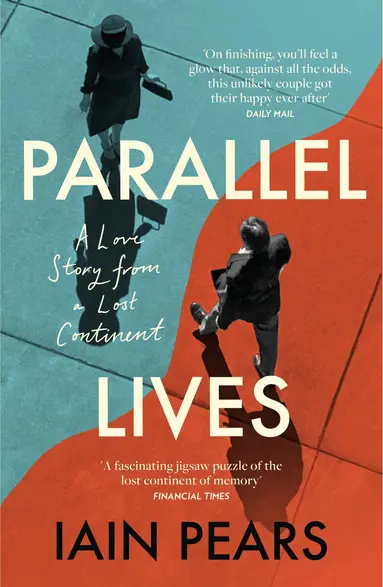
Parallel Lives
Dubbelkollat idag
Jämför 1 butik
- Bokus, 88 kr, frakt enligt butiken. Till butik (öppnas i ny flik)
I lagerFrakt: se butikenDubbelkollad 04:51
88 kr
Lägst

Priser från butikernas flöden kan ha ändrats: det är priset hos butiken som gäller, så kontrollera det innan du handlar.
Prishistorik
Köp nu eller vänta?
Just nu kostar produkten 88 kr — 1 kr över det lägsta vi sett på 1 månad.
Under den tiden har det oftast legat runt 90 kr.
Pris idag
88 kr
- Lägst
- 87 kr
- Snitt
- 134 kr
- Högst
- 308 kr
| 2026-09-15 | 87 kr · Lägst hos Bokus |
|---|---|
| 2026-09-30 | 302 kr · Lägst hos Bokus |
| 2026-10-04 | 308 kr · Lägst hos Bokus |
| 2026-10-10 | 88 kr · Lägst hos Bokus |
Om produkten
This is the simplest tale in the world
Läs merLäs mindre
Two people meet and fall in love. But the route which brought Larissa Salmina and Francis Haskell to a backstreet Venetian restaurant in 1962 was anything but straightforward. Larissa was born in northern Russia, the daughter of a Soviet army officer from a noble family who survived the siege of Leningrad by eating cats' tails and being evacuated over the ice. Francis was the grandson of an Iraqi Jew, forever feeling out of place in his adopted country of England. How they could meet and instantly understand each other so profoundly that both were prepared to risk heartbreak, and in her case, retribution, to be together is the story of this book.Escaping Leningrad, teenage Larissa lived in the Urals surrounded by Spanish revolutionaries, went feral and after the war rose to become the youngest Commissar in the Soviet Union and Keeper of Italian Drawings at the Hermitage. She took the Russian contribution to the Venice Biennale in 1962 and lost it on the journey. She briefly absconded with her supervisor's corpse, developed a useful sideline in forgery, and stole ("I didn't steal it. I liberated it") a Matisse from the Italian government. She was a trained connoisseur and could spot a Tiepolo at 100 yards.Francis was a distinguished art historian, comfortably at home in King's College Cambridge. But he was lonely, self-doubting and had all but abandoned hope of falling in love, or finding anyone who could love him. Larissa swept away all the years of anguish in one meal. Bestselling novelist and art historian Iain Pears' fabulous book brings into sharp focus the strange world of the Soviet Union, and the even stranger world of a certain variety of the English elite. It seeks to show how leaving the Soviet Union was a sacrifice for her and how it was the English man, not the Russian woman, who was set free because of their meeting.Iain Pears knew both his principal characters well. His book is a story of Europe; not the Europe of geographical and ideological divisions but of a certain mentality which was common to a few on both sides of the Iron Curtain. Whatever their differences in nationality, language, and politics, both Larissa and Francis were members of a unified, pan-European culture which paid little heed to the divisions which so pre-occupied most people of the age. It also operated by very different rules and values to the societies in which they existed. It was a world of dancers, exiles, and the occasional spy, of artists, aristocrats, and academics. It consisted of people who only felt safe when they were away from home, were comfortable only in the company of foreigners. It is a tale of a world we seem to have lost.