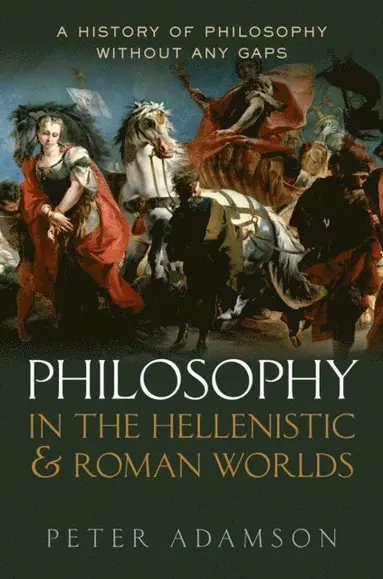
Philosophy in the Hellenistic and Roman Worlds
Dubbelkollat idag
Jämför 1 butik
- Bokus, 110 kr, frakt enligt butiken. Till butik (öppnas i ny flik)
I lagerFrakt: se butikenDubbelkollad 08:51
110 kr
Lägst

Priser från butikernas flöden kan ha ändrats: det är priset hos butiken som gäller, så kontrollera det innan du handlar.
Prishistorik
Köp nu eller vänta?
Just nu kostar produkten 110 kr — 38 kr över det lägsta vi sett på 1 månad.
Under den tiden har det oftast legat runt 110–120 kr.
Pris idag
110 kr
- Lägst
- 72 kr
- Snitt
- 107 kr
- Högst
- 121 kr
| 2026-09-15 | 119 kr · Lägst hos Bokus |
|---|---|
| 2026-09-19 | 108 kr · Lägst hos Bokus |
| 2026-09-22 | 121 kr · Lägst hos Bokus |
| 2026-10-02 | 72 kr · Lägst hos Bokus |
| 2026-10-11 | 110 kr · Lägst hos Bokus |
| 2026-10-22 | 121 kr · Lägst hos Bokus |
| 2026-10-26 | 110 kr · Lägst hos Bokus |
Om produkten
Philosophy in the Hellenistic and Roman Worlds
Läs merLäs mindre
Peter Adamson offers an accessible, humorous tour through a period of eight hundred years when some of the most influential of all schools of thought were formed: from the third century BC to the sixth century AD. He introduces us to Cynics and Skeptics, Epicureans and Stoics, emperors and slaves, and traces the development of Christian and Jewish philosophy and of ancient science. Chapters are devoted to such major figures as Epicurus, Lucretius, Cicero, Seneca, Plotinus, and Augustine. But in keeping with the motto of the series, the story is told ''without any gaps,'' providing an in-depth look at less familiar topics that remains suitable for the general reader. For instance, there are chapters on the fascinating but relatively obscure Cyrenaic philosophical school, on pagan philosophical figures like Porphyry and Iamblichus, and extensive coverage of the Greek and Latin Christian Fathers who are at best peripheral in most surveys of ancient philosophy. A major theme of the book is in fact the competition between pagan and Christian philosophy in this period, and the Jewish tradition also appears in the shape of Philo of Alexandria. Ancient science is also considered, with chapters on ancient medicine and the interaction between philosophy and astronomy. Considerable attention is paid also to the wider historical context, for instance by looking at the ascetic movement in Christianity and how it drew on ideas from Hellenic philosophy. From the counter-cultural witticisms of Diogenes the Cynic to the subtle skepticism of Sextus Empiricus, from the irreverent atheism of the Epicureans to the ambitious metaphysical speculation of Neoplatonism, from the ethical teachings of Marcus Aurelius to the political philosophy of Augustine, the book gathers together all aspects of later ancient thought in an accessible and entertaining way.