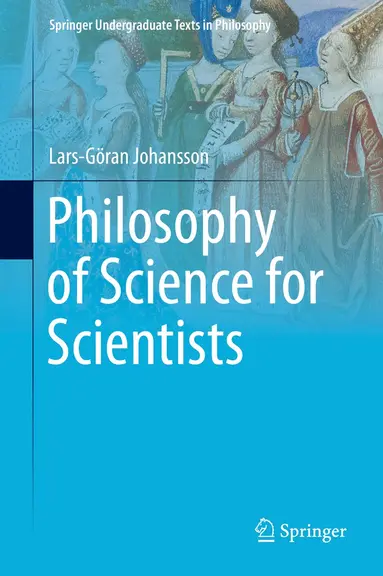
Philosophy of Science for Scientists
- Vikt 0,55 kg
934 krhos Bokus · exkl. frakt
285 kr skillnad mellan billigaste och dyraste butik i lager
Dubbelkollade priser
Jämför 3 butiker
- Bokus, 934 kr, frakt enligt butiken. Till butik (öppnas i ny flik)
I lagerFrakt: se butikenDubbelkollad 07:51
934 kr
Lägst
- Akademibokhandeln, 1 219 kr, frakt enligt butiken. Till butik (öppnas i ny flik)
I lagerFrakt: se butikenDubbelkollad 07:53
1 219 kr
- Adlibris, 923 kr, frakt enligt butiken. Till butik (öppnas i ny flik)
Slut i lagerFrakt: se butikenDubbelkollad 27 okt. 09:10
923 kr


Priser från butikernas flöden kan ha ändrats: det är priset hos butiken som gäller, så kontrollera det innan du handlar.
Prishistorik
Köp nu eller vänta?
Just nu kostar produkten 934 kr — 88 kr över det lägsta vi sett på 1 månad.
Under den tiden har det oftast legat runt 920 kr.
Pris idag
934 kr
- Lägst
- 846 kr
- Snitt
- 918 kr
- Högst
- 934 kr
| 2026-09-15 | 857 kr · Lägst hos Adlibris |
|---|---|
| 2026-09-17 | 899 kr · Lägst hos Bokus |
| 2026-09-18 | 846 kr · Lägst hos Bokus |
| 2026-09-20 | 914 kr · Lägst hos Bokus |
| 2026-09-22 | 923 kr · Lägst hos Bokus |
| 2026-09-26 | 914 kr · Lägst hos Bokus |
| 2026-09-28 | 923 kr · Lägst hos Bokus |
| 2026-10-17 | 934 kr · Lägst hos Bokus |
| 2026-10-20 | 923 kr · Lägst hos Bokus |
| 2026-10-27 | 934 kr · Lägst hos Bokus |
Om produkten
This textbook offers an introduction to the philosophy of science
Läs merLäs mindre
It helps undergraduate students from the natural, the human and social sciences to gain an understanding of what science is, how it has developed, what its core traits are, how to distinguish between science and pseudo-science and to discover what a scientific attitude is. It argues against the common assumption that there is fundamental difference between natural and human science, with natural science being concerned with testing hypotheses and discovering natural laws, and the aim of human and some social sciences being to understand the meanings of individual and social group actions. Instead examines the similarities between the sciences and shows how the testing of hypotheses and doing interpretation/hermeneutics are similar activities. The book makes clear that lessons from natural scientists are relevant to students and scholars within the social and human sciences, and vice versa. It teaches its readers howto effectively demarcate between science and pseudo-science and sets criteria for true scientific thinking. Divided into three parts, the book first examines the question What is Science? It describes the evolution of science, defines knowledge, and explains the use of and need for hypotheses and hypothesis testing. The second half of part I deals with scientific data and observation, qualitative data and methods, and ends with a discussion of theories on the development of science. Part II offers philosophical reflections on four of the most important concepts in science: causes, explanations, laws and models. Part III presents discussions on philosophy of mind, the relation between mind and body, value-free and value-related science, and reflections on actual trends in science.
Specifikationer
Fakta
- Vikt
- 0,55 kg
- GTIN
- 09783319265490
Uppgifter från tillverkare och butiker.