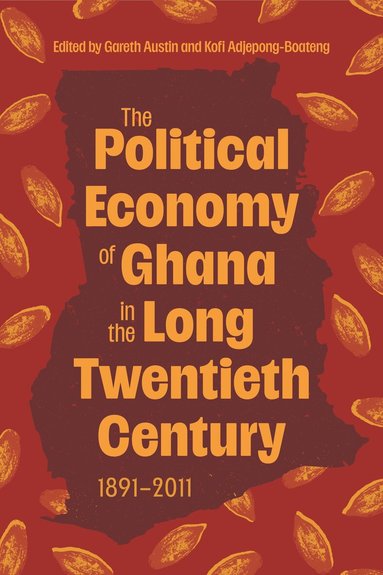
Political Economy of Ghana in the Long Twentieth Century
- Vikt 0,63 kg
529 krhos Buyersclub · exkl. frakt
240 kr skillnad mellan billigaste och dyraste butik i lager
Dubbelkollat idag
Jämför 3 butiker
- Buyersclub, 529 kr, frakt enligt butiken. Till butik (öppnas i ny flik)
I lagerFrakt: se butikenDubbelkollad 06:28
529 kr
Lägst
- Bokus, 595 kr, frakt enligt butiken. Till butik (öppnas i ny flik)
I lagerFrakt: se butikenDubbelkollad 06:51
595 kr
- Akademibokhandeln, 769 kr, frakt enligt butiken. Till butik (öppnas i ny flik)
I lagerFrakt: se butikenDubbelkollad 06:53
769 kr


Priser från butikernas flöden kan ha ändrats: det är priset hos butiken som gäller, så kontrollera det innan du handlar.
Prishistorik
Köp nu eller vänta?
Pris idag
529 kr
- Lägst
- 529 kr
- Snitt
- 610 kr
- Högst
- 769 kr
| 2026-10-14 | 769 kr · Lägst hos Akademibokhandeln |
|---|---|
| 2026-10-15 | 595 kr · Lägst hos Bokus |
| 2026-10-20 | 529 kr · Lägst hos Buyersclub |
Om produkten
Political Economy of Ghana in the Long Twentieth Century
Läs merLäs mindre
A major study of modern Ghana's political economy, tracing how cocoa shaped the country's economic transformation, political change and enduring inequalities.This is the first study of the interaction of politics and economics of Ghana across the whole 'cocoa era', the period from when the country began to export cocoa beans in the late nineteenth century to the beginning of commercial petroleum exports in 2011. Ghana has been described as the most successful example of an indigenous 'cash crop revolution' in the early colonial period, which took the Gold Coast from producing no cocoa in 1890 to the world-leader twenty years later. The most prosperous 'peasant' - or rather, small-scale rural capitalist - economy in colonial Africa, embarked on import-substitution industrialization under the first president of independent Ghana (1957), Kwame Nkrumah. A period of mostly military rule followed from 1966, with the economy moving from stagnation to catastrophic implosion from 1975 to 1983. The collapse was reversed by the paradoxical adoption of economic liberalization under the left-wing 'revolutionary' government of J. J. Rawlings, followed by sustained economic growth into the petroleum era. Political liberalization followed, with the Fourth Republic established in 1992. Economic transformation, however, has been defined by urbanisation without industrialisation, and regional and social inequalities persist.The volume unites economists, economic historians, political historians and political scientists. It offers a broad approach, not confined to cocoa and considering political, economic and social history within a political economy perspective. Chapters draw on primary research, including archival and in some cases oral sources. Themes include the long-term dynamics of cocoa production, the political and economic impact of external trade shocks, inequalities, the long-term relationship between state and society, Nkrumah's foreign policy, the contested evolution of institutions such as the Bank of Ghana and cocoa cooperatives, a reconsideration of small-scale gold mining and the debates over post-independence economic policy.
Specifikationer
Fakta
- Vikt
- 0,63 kg
- GTIN
- 09781837653140
Uppgifter från tillverkare och butiker.