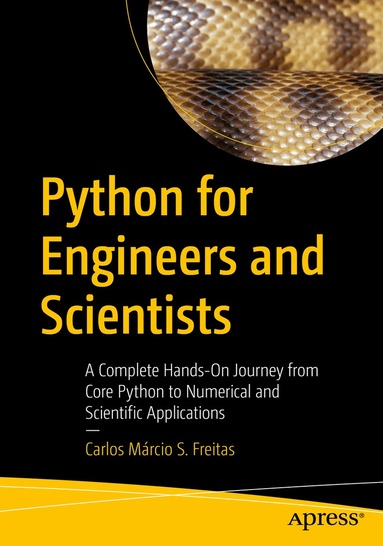
Carlos Márcio da Silva Freitas
Python for Engineers and Scientists
780 krhos Bokus · exkl. frakt
239 kr skillnad mellan billigaste och dyraste butik i lager
Dubbelkollat idag
Jämför 2 butiker
- Bokus, 780 kr, frakt enligt butiken. Till butik (öppnas i ny flik)
I lagerFrakt: se butikenDubbelkollad 14:51
780 kr
Lägst
- Akademibokhandeln, 1 019 kr, frakt enligt butiken. Till butik (öppnas i ny flik)
I lagerFrakt: se butikenDubbelkollad 14:53
1 019 kr

Priser från butikernas flöden kan ha ändrats: det är priset hos butiken som gäller, så kontrollera det innan du handlar.
Prishistorik
Köp nu eller vänta?
Just nu kostar produkten 780 kr — 16 kr över det lägsta vi sett på 2 veckor.
Under den tiden har det oftast legat runt 760–780 kr.
Pris idag
780 kr
- Lägst
- 764 kr
- Snitt
- 785 kr
- Högst
- 989 kr
| 2026-10-01 | 989 kr · Lägst hos Akademibokhandeln |
|---|---|
| 2026-10-02 | 764 kr · Lägst hos Bokus |
| 2026-10-10 | 780 kr · Lägst hos Bokus |
Om produkten
Python for Engineers and Scientists
Läs merLäs mindre
This book equips technical professionals with a complete, structured path to mastering Python for real-world engineering and scientific applications. As Python becomes central to research labs, automation, simulation, and data-driven engineering, the learning curve remains steep. This book bridges that gap with a practical roadmap from fundamentals to professional-grade scientific computing.The book begins by building a strong programming foundation-covering Python's architecture, essential syntax, data structures, modules, functions, control flow, and object-oriented design. Readers learn not only how to write Python, but why the language behaves the way it does, ensuring deep understanding and strong problem-solving skills. From there, the focus shifts to practical engineering tools. Dedicated chapters train readers in file handling, math modules, and key scientific libraries including NumPy, SciPy, Pandas, and Matplotlib, enabling efficient computation, signal processing, data analysis, and high-quality visualization. Advanced chapters then showcase Python's versatility through GUI development with Kivy, database work with SQLAlchemy, and hands-on control system modeling and analysis. Each topic is rooted in industry and academic scenarios, making the content directly applicable to automation, simulation, data workflows, and engineering computation.Whether you're a student building foundational skills or a professional modernizing engineering workflows, this guide provides the programming depth, scientific tools, and applied knowledge needed to use Python confidently for prototyping, simulation, analysis, and automation. It is the one-stop resource for mastering Python in technical disciplines.What you will learn:Learn core Python programming concepts, including variables, loops, functions, and object-oriented principles in a scientific and engineering context.Build strong skills in key scientific Python libraries such as NumPy, Pandas, Matplotlib, and SciPy for computation, analysis, and visualization.Apply Python to real-world engineering scenarios, including dynamic control systems and automation workflows.Develop interactive engineering applications by creating graphical user interfaces (GUIs) with Kivy. Who this book is for:This book is intended for practicing engineers and scientists across various disciplines of engineering who need to use Python for complex problem-solving, simulation, and data analysis in their work.