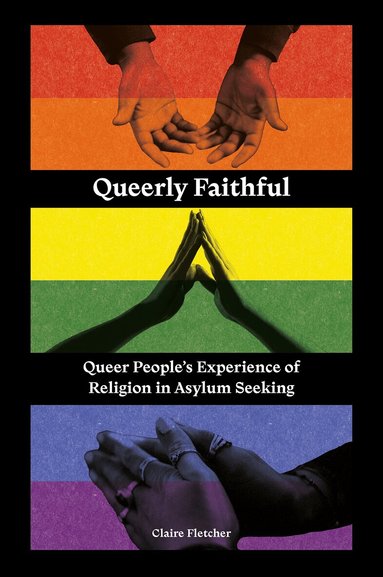
Queerly Faithful
265 krhos Bokus · exkl. frakt
84 kr skillnad mellan billigaste och dyraste butik i lager
Dubbelkollat idag
Jämför 2 butiker
- Bokus, 265 kr, frakt enligt butiken. Till butik (öppnas i ny flik)
I lagerFrakt: se butikenDubbelkollad 16:51
265 kr
Lägst
- Akademibokhandeln, 349 kr, frakt enligt butiken. Till butik (öppnas i ny flik)
I lagerFrakt: se butikenDubbelkollad 16:53
349 kr

Priser från butikernas flöden kan ha ändrats: det är priset hos butiken som gäller, så kontrollera det innan du handlar.
Prishistorik
Köp nu eller vänta?
Pris idag
265 kr
- Lägst
- 265 kr
- Snitt
- 307 kr
- Högst
- 349 kr
| 2026-10-15 | 349 kr · Lägst hos Akademibokhandeln |
|---|---|
| 2026-10-16 | 265 kr · Lägst hos Bokus |
Om produkten
Queerly Faithful
Läs merLäs mindre
The ebook edition of this title is Open Access and freely available to read online.An assumption present in refugee status determinations is that there is an incompatibility of religious faith and queer subjectivity. Queerly Faithful considers religious experiences throughout the lives of queer people who seek asylum to show the complexity of queer people's lives in country of origin, the legal asylum process and rebuilding lives in host countries. How do queer people experience religion before and after arrival into the UK to claim asylum?Providing new empirical data in an under researched area, Fletcher examines the nexus of queer subjectivity, religion and asylum seeking, highlighting life history interviews with queer people seeking asylum and with those who respond to them, either in a faith-based context, legal provision, or NGO responses. By exploring three key areas country-of-origin (CoO) experience, the intersection of the legal and social in the UK asylum context, and religious responses in the UK to those who are forced to flee due to queer subjectivity Fletcher shows how the stereotypical assumption that faith and queer subjectivity are not compatible is not only incorrect but can limit people's ability to gain refugee protection. Challenging dominant narratives of a homogenously homophobic global south by demonstrating the complexity of strategies interlocutors employ to remain in CoO, the research also shows how religious responses can provide help and healing for LGBTQI+ people who seek asylum in the UK.Making recommendations on how faith spaces can become more visibly welcoming to those with queer subjectivities who are within the asylum process, this is important reading for academics and students in the sub-disciplines of forced migration studies, sexuality studies, sociology of religion and queer feminist theory.