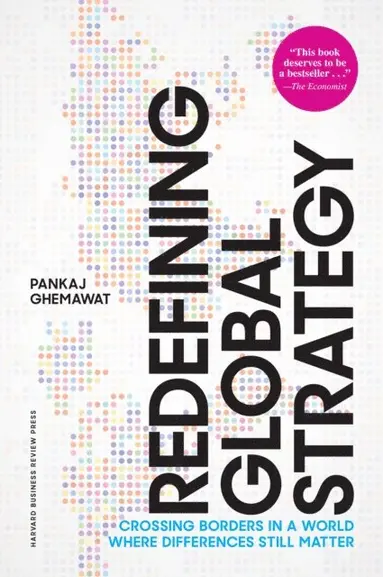
Redefining Global Strategy, with a New Preface
Dubbelkollat idag
Jämför 1 butik
- Bokus, 464 kr, frakt enligt butiken. Till butik (öppnas i ny flik)
I lagerFrakt: se butikenDubbelkollad 00:51
464 kr
Lägst

Priser från butikernas flöden kan ha ändrats: det är priset hos butiken som gäller, så kontrollera det innan du handlar.
Prishistorik
Köp nu eller vänta?
Just nu kostar produkten 464 kr — 10 kr över det lägsta vi sett på 1 månad.
Pris idag
464 kr
- Lägst
- 454 kr
- Snitt
- 458 kr
- Högst
- 464 kr
| 2026-09-15 | 454 kr · Lägst hos Bokus |
|---|---|
| 2026-10-13 | 464 kr · Lägst hos Bokus |
Om produkten
Redefining Global Strategy, with a New Preface
Läs merLäs mindre
New Tools for Succeeding GloballyWhy do so many global strategies fail--despite companies'' powerful brands and other border-crossing advantages? Because a one-size-fits-all strategy no longer stands a chance.When firms believe in the illusions of a "flat" world and the death of distance, they charge across borders as if the globe were one seamless marketplace. But cross-border differences are larger than we assume. Most economic activity--including trade, real and financial investment, tourism, and communication--happens locally, not internationally. In this "semiglobalized" approach, companies can cross borders more profitably by basing their strategies on the geopolitical differences that matter; they must identify the barriers their strategies will have to overcome, and they must build bridges to cross those barriers. Based on rigorous research, Pankaj Ghemawat shows how to create successful strategies and provides practical management tools so you can:Assess the cultural, administrative, geographic, and economic differences between regions at the industry level--and decide which ones require attentionTrack the implications of the specific border-crossing actions that will impact your company''s ability to create value the mostGenerate superior performance through strategies that are optimized for the three A''s: adaptation (adjusting to differences), aggregation (overcoming differences), and arbitrage (exploiting differences)Using in-depth examples, Ghemawat reveals how companies such as Cemex, Toyota, Procter & Gamble, Tata Consultancy Services, IBM, and GE Healthcare are adroitly managing cross-border differences. He also shares examples of other well-known companies that have failed at this challenge. Crucial for any business competing across borders, Redefining Global Strategy will help you make the most of our semiglobalized world.