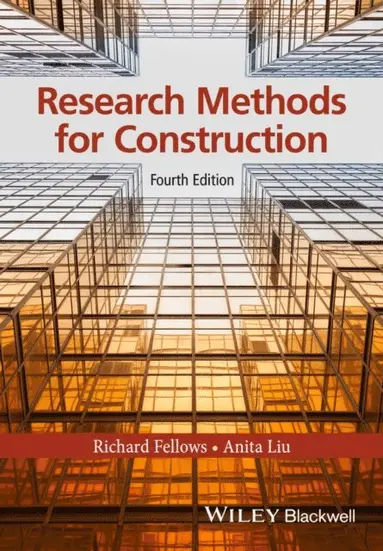
Research Methods for Construction
Dubbelkollat idag
Jämför 1 butik
- Bokus, 554 kr, frakt enligt butiken. Till butik (öppnas i ny flik)
I lagerFrakt: se butikenDubbelkollad 06:51
554 kr
Lägst

Priser från butikernas flöden kan ha ändrats: det är priset hos butiken som gäller, så kontrollera det innan du handlar.
Prishistorik
Köp nu eller vänta?
Just nu kostar produkten 554 kr — 12 kr över det lägsta vi sett på 1 månad.
Under den tiden har det oftast legat runt 550–600 kr.
Pris idag
554 kr
- Lägst
- 542 kr
- Snitt
- 573 kr
- Högst
- 597 kr
| 2026-09-15 | 542 kr · Lägst hos Bokus |
|---|---|
| 2026-09-17 | 589 kr · Lägst hos Bokus |
| 2026-09-22 | 597 kr · Lägst hos Bokus |
| 2026-09-27 | 542 kr · Lägst hos Bokus |
| 2026-09-29 | 597 kr · Lägst hos Bokus |
| 2026-10-09 | 554 kr · Lägst hos Bokus |
| 2026-10-13 | 597 kr · Lägst hos Bokus |
| 2026-10-16 | 554 kr · Lägst hos Bokus |
Om produkten
Research Methods for Construction
Läs merLäs mindre
Research Methods for Construction will help you instil rigour into your problem-solving, and into your reports and publications. It will be of value to construction, surveying, architecture and civil engineering students undertaking research, whether for bachelors and masters degree dissertations, or for masters and doctoral research degree theses. Now in its Fourth Edition, this remains one of the few books to provide guidance on research formulation, methodologies, and methods specifically for construction students. Three main sections - Producing a Proposal, Executing the Research and Reporting the Results discuss the key issues in research and examine the primary approaches, both qualitative and quantitative. The methods adopted for scientific and engineering experiments, model building and simulations are discussed, as well as those employed for research into management, social and economic issues. The authors examine the requirements for data and analysis, including the important statistical considerations and a range of qualitative techniques that enable construction researchers to appreciate what needs to be evaluated in devising how research may be carried out effectively and efficiently. This new edition has been updated to reflect current debates and concerns, including ethical issues, legislation and codes of practice concerning the collection, processing, storage, use and disposal of data. Pressures of time and funding to carry out the empirical work all too often lead to a lack of attention to how the study should be done and why. The authors address the importance of explaining the philosophical approach adopted (ontology, epistemology) and the consequent methodology. They advocate close scrutiny of the methods available for appropriateness, both academically and practically. The fundamental theme of the book remains to facilitate a researcher's informed and justified selection of a philosophical paradigm and of appropriate methods to execute the research.