Risk
Dubbelkollat idag
Jämför 1 butik
- Bokus, 433 kr, frakt enligt butiken. Till butik (öppnas i ny flik)
I lagerFrakt: se butikenDubbelkollad 04:17
433 kr
Lägst

Priser från butikernas flöden kan ha ändrats: det är priset hos butiken som gäller, så kontrollera det innan du handlar.
Prishistorik
Köp nu eller vänta?
Just nu kostar produkten 433 kr — 26 kr över det lägsta vi sett på 1 månad.
Under den tiden har det oftast legat runt 430–440 kr.
Pris idag
433 kr
- Lägst
- 407 kr
- Snitt
- 434 kr
- Högst
- 441 kr
| 2026-09-15 | 436 kr · Lägst hos Bokus |
|---|---|
| 2026-09-22 | 441 kr · Lägst hos Bokus |
| 2026-09-26 | 407 kr · Lägst hos Bokus |
| 2026-09-28 | 441 kr · Lägst hos Bokus |
| 2026-10-13 | 416 kr · Lägst hos Bokus |
| 2026-10-18 | 441 kr · Lägst hos Bokus |
| 2026-10-22 | 433 kr · Lägst hos Bokus |
Om produkten
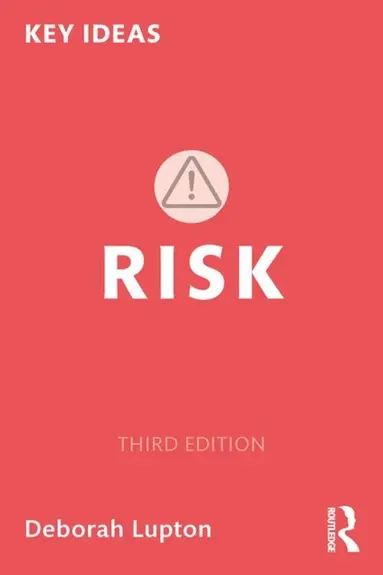
Risk
Läs merLäs mindre
We are living in a world in which the existence of risk is constantly debated, misinformation and disinformation are rife and spread quickly and easily through online media, and where governments and institutions continue to avoid taking decisive action even when there is general agreement that a serious threat exists. Understanding how people, social groups and social organizations understand, respond to and act on threats, hazards and dangers is more important than ever. In Risk, Deborah Lupton asserts the ongoing importance of the analysis of risk in our age of permacrisis and mounting scepticism about experts and science, calling for a †̃re-turnâ€TM to risk theory in the social sciences.The book outlines the three major approaches to risk in social and cultural theory, devoting a chapter to each. The first approach draws upon the work of Mary Douglas to articulate the cultural/symbolic perspective on risk. The second approach is that of the risk society perspective, based on the writings of Ulrich Beck and Anthony Giddens. The third approach covered is that of the governmentality perspective, which builds on Michel Foucaultâ€TMs work. Three other chapters examine in detail the relationship between concepts of risk and concepts of selfhood and the body, the notion of Otherness and how this influences the ways in which people respond to and think about risk, and the pleasures of voluntary risk-taking, including discussion of edgework. An entirely new chapter has been added to this edition, focusing on the risks posed by misinformation and denial in the context of climate change and the COVID-19 pandemic. This chapter discusses the politics of post-truth cultures and the powerful networks of actor and organizations that together work to challenge science and manufacture dissent against attempts to tackle these crises.This new edition of Risk is an essential introduction to the topic of risk for students and academics in the social sciences and humanities.