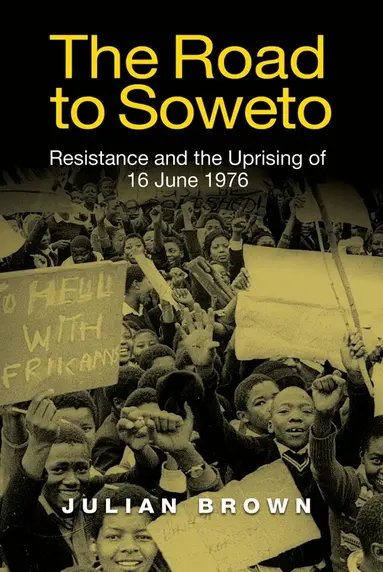
Road to Soweto
- Vikt 0,33 kg
309 krhos Bokus · exkl. frakt
90 kr skillnad mellan billigaste och dyraste butik i lager
Dubbelkollat idag
Jämför 2 butiker
- Bokus, 309 kr, frakt enligt butiken. Till butik (öppnas i ny flik)
I lagerFrakt: se butikenDubbelkollad 18:51
309 kr
Lägst
- Akademibokhandeln, 399 kr, frakt enligt butiken. Till butik (öppnas i ny flik)
I lagerFrakt: se butikenDubbelkollad 19:19
399 kr

Priser från butikernas flöden kan ha ändrats: det är priset hos butiken som gäller, så kontrollera det innan du handlar.
Prishistorik
Köp nu eller vänta?
Just nu kostar produkten 309 kr — 8 kr över det lägsta vi sett på 1 månad.
Under den tiden har det oftast legat runt 300–310 kr.
Pris idag
309 kr
- Lägst
- 301 kr
- Snitt
- 307 kr
- Högst
- 312 kr
| 2026-09-15 | 301 kr · Lägst hos Bokus |
|---|---|
| 2026-09-18 | 303 kr · Lägst hos Bokus |
| 2026-09-21 | 304 kr · Lägst hos Bokus |
| 2026-09-23 | 305 kr · Lägst hos Bokus |
| 2026-09-24 | 304 kr · Lägst hos Bokus |
| 2026-09-28 | 307 kr · Lägst hos Bokus |
| 2026-10-02 | 309 kr · Lägst hos Bokus |
| 2026-10-08 | 312 kr · Lägst hos Bokus |
| 2026-10-09 | 311 kr · Lägst hos Bokus |
| 2026-10-12 | 309 kr · Lägst hos Bokus |
| 2026-10-16 | 311 kr · Lägst hos Bokus |
| 2026-10-17 | 309 kr · Lägst hos Bokus |
| 2026-10-20 | 307 kr · Lägst hos Bokus |
| 2026-10-24 | 306 kr · Lägst hos Bokus |
| 2026-10-27 | 308 kr · Lägst hos Bokus |
Om produkten
Road to Soweto
Läs merLäs mindre
A new history of the 1976 Soweto Uprising and the events leading to it in the preceding decade, that will transform our understanding of the historical evolution of the struggle against apartheid.This revisionary account of the Soweto Uprising of June 1976 and the decade preceding it transforms our understanding of what led to this crucial flashpoint of South Africa's history. Brown argues that far from there being "quiescence" following the Sharpeville Massacre and the suppression of African opposition movements, during which they went underground, this period was marked by experiments in resistance and attempts to develop new forms of politics that prepared the ground for the Uprising. Students at South Africa's segregated universities began to re-organise themselves as a political force; new ideas about race reinvigorated political thought; debates around confrontation shaped the development of new forms of protest. The protest then began to move off university campuses and onto the streets: through the independent actions of workers in Durban, and attempts by students to link their struggles with a broader agenda. These actions made protest public once again, and helped establish the patterns of popular action and state response that would come to shape the events in Soweto on 16 June 1976.Julian Brown is a Lecturer in the Department of Political Studies at the University of the Witwatersrand, Johannesburg.Southern Africa (South Africa, Namibia, Lesotho, Swaziland & Botswana): Jacana'throws new light on the background to the Soweto Uprising, providing insight into white and black student politics, worker protest and broader dissent' - William Beinart, University of Oxford'an extremely important contribution to the historiography on protest in South Africa. It links black and white student protests (too often studied in isolation from one another) to workers' movements by looking at the changing forms of protest during the 1960s and 1970s, and the apartheid government's changing responses.' - Anne Heffernan, University of the Witwatersrand'By showing how the Soweto Uprising served as a precursor for later historical and political events, the author convincingly shows the continuity from one from one protest and decade to the next.' - Dawne Curry, University of Nebraska-Lincoln
Specifikationer
Fakta
- Vikt
- 0,33 kg
- GTIN
- 09781847013484
Uppgifter från tillverkare och butiker.