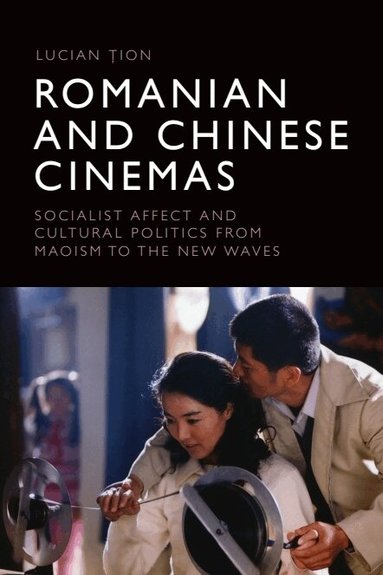
Romanian and Chinese Cinemas
Bra pris nuLägsta priset på 2 veckor
267 kr289 kr−7% senaste veckanhos Bokus · exkl. frakt
Jämfört med det lägsta pris vi sett de 30 dagarna före sänkningen.
82 kr skillnad mellan billigaste och dyraste butik i lager
Dubbelkollat idag
Jämför 2 butiker
- Bokus, 267 kr, frakt enligt butiken. Till butik (öppnas i ny flik)
I lagerFrakt: se butikenDubbelkollad 20:51
267 kr
Lägst
- Akademibokhandeln, 349 kr, frakt enligt butiken. Till butik (öppnas i ny flik)
I lagerFrakt: se butikenDubbelkollad 20:53
349 kr

Priser från butikernas flöden kan ha ändrats: det är priset hos butiken som gäller, så kontrollera det innan du handlar.
Prishistorik
Köp nu eller vänta?
Just nu kostar produkten 267 kr — det lägsta vi sett på 2 veckor.
Under den tiden har det oftast legat runt 270–290 kr.
Pris idag
267 kr
- Lägst
- 267 kr
- Snitt
- 285 kr
- Högst
- 379 kr
| 2026-10-03 | 379 kr · Lägst hos Akademibokhandeln |
|---|---|
| 2026-10-04 | 289 kr · Lägst hos Bokus |
| 2026-10-11 | 267 kr · Lägst hos Bokus |
Om produkten
Romanian and Chinese Cinemas
Läs merLäs mindre
Drawing on what used to be the erstwhile internationalist cultural space of Communist Eurasia, the author reads socialist-era and postsocialist films made in Romania and China as promoting a common aesthetics predicated on the miserabilism of Third Cinema. The book argues that, despite indictments that socialist cultures were saturated with the oppressing ideology of socialist realism in the 1950s and various forms of indoctrination thereafter, in practice, film directors had the leverage to tackle social issues even in those works that are deemed today "propagandist."Refusing to endorse contemporary theories that seek to align the Romanian and the Chinese New Waves solely to Western cinematic practices, the author argues that China's fifth and sixth generation films as well as New Romanian Cinema are hugely indebted to socialist-era themes, as well as to the dogmatism of socialist realism. Identifying continuity rather than rupture between the socialist past and the capitalist present, the author seeks to redress an imbalance that contemporary scholars of Romanian and Chinese cinemas oftentimes ignore.