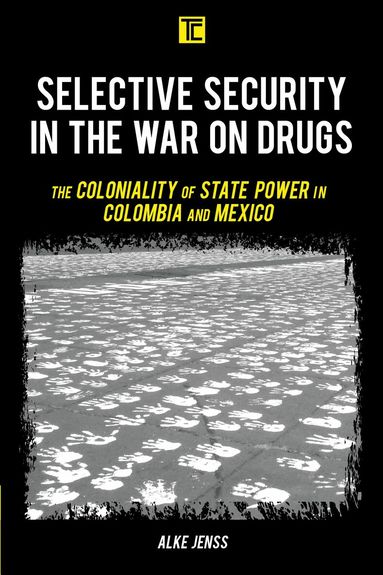
Selective Security in the War on Drugs
- Vikt 0,42 kg
417 krhos Bokus · exkl. frakt
122 kr skillnad mellan billigaste och dyraste butik i lager
Dubbelkollat idag
Jämför 2 butiker
- Bokus, 417 kr, frakt enligt butiken. Till butik (öppnas i ny flik)
I lagerFrakt: se butikenDubbelkollad 08:51
417 kr
Lägst
- Akademibokhandeln, 539 kr, frakt enligt butiken. Till butik (öppnas i ny flik)
I lagerFrakt: se butikenDubbelkollad 08:53
539 kr

Priser från butikernas flöden kan ha ändrats: det är priset hos butiken som gäller, så kontrollera det innan du handlar.
Prishistorik
Köp nu eller vänta?
Pris idag
417 kr
- Lägst
- 415 kr
- Snitt
- 427 kr
- Högst
- 539 kr
| 2026-10-07 | 539 kr · Lägst hos Akademibokhandeln |
|---|---|
| 2026-10-08 | 415 kr · Lägst hos Bokus |
| 2026-10-10 | 418 kr · Lägst hos Bokus |
| 2026-10-11 | 417 kr · Lägst hos Bokus |
| 2026-10-12 | 415 kr · Lägst hos Bokus |
| 2026-10-16 | 418 kr · Lägst hos Bokus |
| 2026-10-17 | 417 kr · Lägst hos Bokus |
Om produkten
Selective Security in the War on Drugs
Läs merLäs mindre
Paramilitaries, crime, and tens of thousands of disappeared persons-the so-called war on drugs has perpetuated violence in Latin America, at times precisely in regions of economic growth. Legal and illegal economy are difficult to distinguish. A failure of state institutions to provide security for its citizens does not sufficiently explain this. Selective Security in the War on Drugs analyzes authoritarian neoliberalism in the war on drugs in Colombia and Mexico. It interprets the "security projects" of the 2000s-when the security provided by the state became ever more selective-as embedded in processes of land appropriation, transformed property relations, and global capital accumulation. By zooming in on security practices in Colombia and Mexico in that decade and juxtaposing the two contexts, this book offers a detailed analysis of the role of the state in violence. To what extent and for whom do states produce order and disorder? Which social forces support and drive such state practices?Expanding the literature on authoritarian neoliberalism and the coloniality of state power-thus linking political economy to postcolonial approaches-the book builds a theoretical lens to study state security practices. Different social groups, enjoying differentiated access to the state, influenced the state discourse on crime to very different extents. Security practices-which oscillated between dispersed organization by a multiplicity of actors and institutionalization with the military-materialized as horrific insecurity for social groups thought of as disposable. In tendency, putting security centerstage disabled dissent. The "security projects" exacerbated contradictions driven by a particular economic model and simultaneously criminalized precisely those that this model had already radically disadvantaged.
Specifikationer
Fakta
- Vikt
- 0,42 kg
- GTIN
- 09781538151112
Uppgifter från tillverkare och butiker.