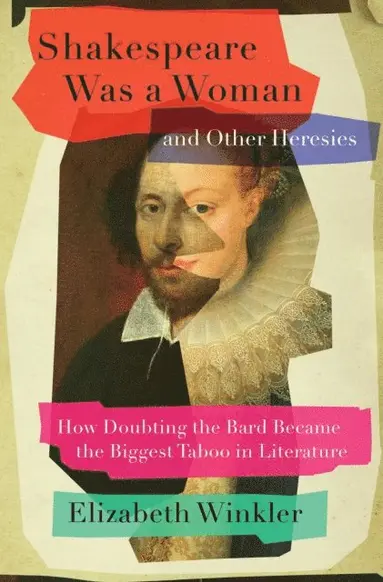
Shakespeare Was a Woman and Other Heresies
Dubbelkollade priser
Jämför 2 butiker
- Bokus, 213 kr, frakt enligt butiken. Till butik (öppnas i ny flik)
I lagerFrakt: se butikenDubbelkollad 00:51
213 kr
Lägst
- Adlibris, 212 kr plus 35 kr frakt. Till butik (öppnas i ny flik)
Slut i lagerFrakt 35 krDubbelkollad 27 okt. 09:10
212 kr


Priser från butikernas flöden kan ha ändrats: det är priset hos butiken som gäller, så kontrollera det innan du handlar.
Prishistorik
Köp nu eller vänta?
Just nu kostar produkten 213 kr — 4 kr över det lägsta vi sett på 1 månad.
Under den tiden har det oftast legat runt 210 kr.
Pris idag
213 kr
- Lägst
- 209 kr
- Snitt
- 210 kr
- Högst
- 213 kr
| 2026-09-15 | 209 kr · Lägst hos Bokus |
|---|---|
| 2026-10-12 | 212 kr · Lägst hos Adlibris |
| 2026-10-27 | 213 kr · Lägst hos Bokus |
Om produkten
Shakespeare Was a Woman and Other Heresies
Läs merLäs mindre
An "extraordinarily brilliant" and "pleasurably naughty" (André Aciman) investigation into the Shakespeare authorship question, exploring how doubting that William Shakespeare wrote his plays became an act of blasphemy...and who the Bard might really be.The theory that Shakespeare may not have written the works that bear his name is the most horrible, unspeakable subject in the history of English literature. Scholars admit that the Bard's biography is a "black hole," yet to publicly question the identity of the god of English literature is unacceptable, even (some say) "immoral." In Shakespeare Was a Woman and Other Heresies, journalist and literary critic Elizabeth Winkler sets out to probe the origins of this literary taboo. Whisking you from London to Stratford-Upon-Avon to Washington, DC, she pulls back the curtain to show how the forces of nationalism and empire, religion and mythmaking, gender and class have shaped our admiration for Shakespeare across the centuries. As she considers the writers and thinkers-from Walt Whitman to Sigmund Freud to Supreme Court justices-who have grappled with the riddle of the plays' origins, she explores who may perhaps have been hiding behind his name. A forgotten woman? A disgraced aristocrat? A government spy? Hovering over the mystery are Shakespeare's plays themselves, with their love for mistaken identities, disguises, and things never quite being what they seem. As she interviews scholars and skeptics, Winkler's interest turns to the larger problem of historical truth-and of how human imperfections (bias, blindness, subjectivity) shape our construction of the past. History is a story, and the story we find may depend on the story we're looking for. "Lively" (The Washington Post), "fascinating" (Amanda Foreman), and "intrepid" (Stacy Schiff), Shakespeare Was a Woman and Other Heresies will forever change how you think of Shakespeare...and of how we as a society decide what's up for debate and what's just nonsense, just heresy.