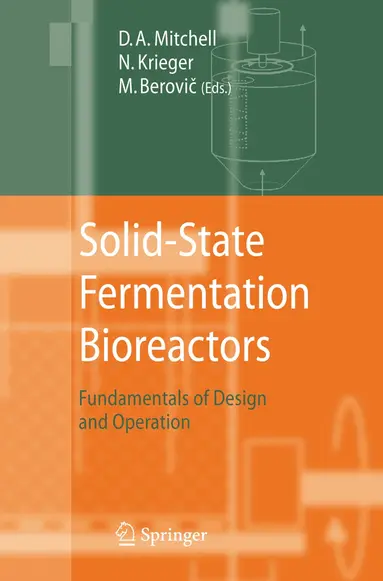
Solid-State Fermentation Bioreactors
Bra pris nuLägsta priset på 1 månad
2 700 kr2 712 kr−0% senaste veckanhos Bokus · exkl. frakt
Jämfört med det lägsta pris vi sett de 30 dagarna före sänkningen.
809 kr skillnad mellan billigaste och dyraste butik i lager
Dubbelkollat idag
Jämför 2 butiker
- Bokus, 2 700 kr, frakt enligt butiken. Till butik (öppnas i ny flik)
I lagerFrakt: se butikenDubbelkollad 08:51
2 700 kr
Lägst
- Akademibokhandeln, 3 509 kr, frakt enligt butiken. Till butik (öppnas i ny flik)
I lagerFrakt: se butikenDubbelkollad 08:53
3 509 kr

Priser från butikernas flöden kan ha ändrats: det är priset hos butiken som gäller, så kontrollera det innan du handlar.
Prishistorik
Köp nu eller vänta?
Just nu kostar produkten 2 700 kr — det lägsta vi sett på 1 månad.
Under den tiden har det oftast legat runt 2 730–2 760 kr.
Pris idag
2 700 kr
- Lägst
- 2 700 kr
- Snitt
- 2 743 kr
- Högst
- 2 794 kr
| 2026-09-15 | 2 794 kr · Lägst hos Bokus |
|---|---|
| 2026-09-17 | 2 752 kr · Lägst hos Bokus |
| 2026-09-18 | 2 751 kr · Lägst hos Bokus |
| 2026-09-20 | 2 750 kr · Lägst hos Bokus |
| 2026-09-23 | 2 755 kr · Lägst hos Bokus |
| 2026-09-24 | 2 751 kr · Lägst hos Bokus |
| 2026-09-25 | 2 744 kr · Lägst hos Bokus |
| 2026-09-28 | 2 748 kr · Lägst hos Bokus |
| 2026-09-30 | 2 755 kr · Lägst hos Bokus |
| 2026-10-02 | 2 764 kr · Lägst hos Bokus |
| 2026-10-05 | 2 767 kr · Lägst hos Bokus |
| 2026-10-10 | 2 746 kr · Lägst hos Bokus |
| 2026-10-11 | 2 734 kr · Lägst hos Bokus |
| 2026-10-12 | 2 727 kr · Lägst hos Bokus |
| 2026-10-16 | 2 734 kr · Lägst hos Bokus |
| 2026-10-17 | 2 725 kr · Lägst hos Bokus |
| 2026-10-19 | 2 730 kr · Lägst hos Bokus |
| 2026-10-20 | 2 722 kr · Lägst hos Bokus |
| 2026-10-22 | 2 712 kr · Lägst hos Bokus |
| 2026-10-24 | 2 724 kr · Lägst hos Bokus |
| 2026-10-27 | 2 727 kr · Lägst hos Bokus |
| 2026-10-30 | 2 733 kr · Lägst hos Bokus |
| 2026-11-01 | 2 700 kr · Lägst hos Bokus |
Om produkten
Solid-State Fermentation Bioreactors
Läs merLäs mindre
Although solid-state fermentation (SSF) has been practiced for many centuries in the preparation of traditional fermented foods, its application to newer products within the framework of modern biotechnology is relatively restricted. It was c- sidered for the production of enzymes in the early 1900s and for the production of penicillin in the 1940s, but interest in SSF waned with the advances in submerged liquid fermentation (SLF) technology. The current dominance of SLF is not s- prising: For the majority of fermentation products, it gives better yields and is e- ier to apply. It is notoriously difficult to control the fermentation conditions in SSF; these difficulties are already apparent at small scale in the laboratory and are exacerbated with increase in scale. However, there are particular circumstances and products for which SSF technology is appropriate. For example, a desire to reuse solid organic wastes from agriculture and food processing rather than simply discarding them leads naturally to the use of SSF. Further, some microbial pr- ucts, such as fungal enzymes and spores, amongst others, are produced in higher yields or with better properties in the environment provided by SSF systems. With recognition of this potential of SSF, a revival of interest began in the mid- 1970s. However, the theoretical base for SSF bioreactor technology only began to be established around 1990.