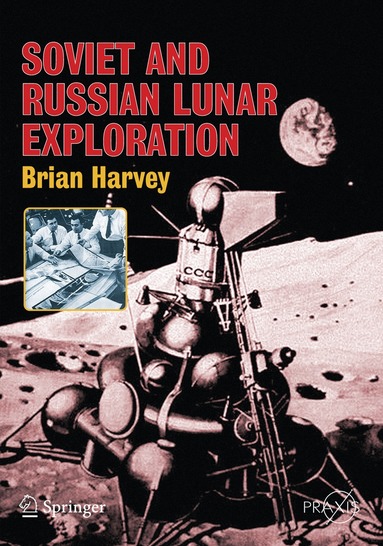
Soviet and Russian Lunar Exploration
- Vikt 0,66 kg
Bra pris nuLägsta priset på 1 månad
550 kr554 kr−0% senaste veckanhos Bokus · exkl. frakt
Jämfört med det lägsta pris vi sett de 30 dagarna före sänkningen.
169 kr skillnad mellan billigaste och dyraste butik i lager
Dubbelkollat idag
Jämför 2 butiker
- Bokus, 550 kr, frakt enligt butiken. Till butik (öppnas i ny flik)
I lagerFrakt: se butikenDubbelkollad 06:51
550 kr
Lägst
- Akademibokhandeln, 719 kr, frakt enligt butiken. Till butik (öppnas i ny flik)
I lagerFrakt: se butikenDubbelkollad 06:53
719 kr

Priser från butikernas flöden kan ha ändrats: det är priset hos butiken som gäller, så kontrollera det innan du handlar.
Prishistorik
Köp nu eller vänta?
Just nu kostar produkten 550 kr — det lägsta vi sett på 1 månad.
Under den tiden har det oftast legat runt 560 kr.
Pris idag
550 kr
- Lägst
- 550 kr
- Snitt
- 558 kr
- Högst
- 569 kr
| 2026-09-15 | 569 kr · Lägst hos Bokus |
|---|---|
| 2026-09-16 | 561 kr · Lägst hos Bokus |
| 2026-09-17 | 560 kr · Lägst hos Bokus |
| 2026-09-19 | 561 kr · Lägst hos Bokus |
| 2026-09-20 | 560 kr · Lägst hos Bokus |
| 2026-09-22 | 561 kr · Lägst hos Bokus |
| 2026-09-23 | 560 kr · Lägst hos Bokus |
| 2026-09-24 | 559 kr · Lägst hos Bokus |
| 2026-09-26 | 560 kr · Lägst hos Bokus |
| 2026-09-30 | 561 kr · Lägst hos Bokus |
| 2026-10-03 | 564 kr · Lägst hos Bokus |
| 2026-10-06 | 562 kr · Lägst hos Bokus |
| 2026-10-09 | 559 kr · Lägst hos Bokus |
| 2026-10-10 | 557 kr · Lägst hos Bokus |
| 2026-10-11 | 556 kr · Lägst hos Bokus |
| 2026-10-17 | 555 kr · Lägst hos Bokus |
| 2026-10-19 | 556 kr · Lägst hos Bokus |
| 2026-10-20 | 555 kr · Lägst hos Bokus |
| 2026-10-29 | 557 kr · Lägst hos Bokus |
| 2026-10-30 | 554 kr · Lägst hos Bokus |
| 2026-10-31 | 550 kr · Lägst hos Bokus |
Om produkten
Soviet and Russian Lunar Exploration
Läs merLäs mindre
When, in July 1969, the Americans decisively beat the Soviet Union in the race to put an astronaut on the moon, this event had profound historical, scientific and political implications. This book tells the story of the Soviet and Russian lunar programme, from its origins to the reconsideration of a lunar programme in the present-day federal Russian space programme. Following Sputnik, the first Soviet lunar flights achieved the key goals of hitting, circling and photographing the moon in 1959. The Soviet Union planned to achieve the biggest prize of them all -the first person to land on the moon - and built all the key spaceships required to do so, such as a lunar orbiter and lander. Brian Harvey describes the techniques devised by the USSR for lunar landing, from the LK lunar module to the LOK lunar orbiter and tested versions in Earth orbit. He asks whether these systems would have worked and, examining how well they were tested, concludes that they would have: the Soviet Union lost the moon race for political, not technical reasons. Designs for moon bases were even drawn up. In the end, the Soviet Union ran an impressive series of robotic missions from 1968 to 1976 to circle the moon, map the far side, conduct scientific observations from orbit, recover samples and rove over the surface. The scientific haul from these missions is surveyed: what was actually learned about the moon, its rocks and the lunar environment, that will be useful for the present plans by the United States to return to the moon and for other countries, such as India and China, to conduct their own lunar exploration.The book opens in Surgut, Siberia, in August 1976, with a largely forgotten event: the return to Earth after a three-day journey from the moon, under a single parachute, of the tiny Luna 24 cabin, with a core sample drilled deep into the Sea of Crises, a remarkable scientific and engineering achievement. It ends with an examination of projected missions, fromplans to explore the far side and set up lunar observatories to the Luna Glob explorer of the 1990s. There is also discussion of lunar tourism, using a modernized version of the Zond spacecraft which flew around the moon from1968 to 1970.
Specifikationer
Fakta
- Vikt
- 0,66 kg
- GTIN
- 09780387218960
Uppgifter från tillverkare och butiker.