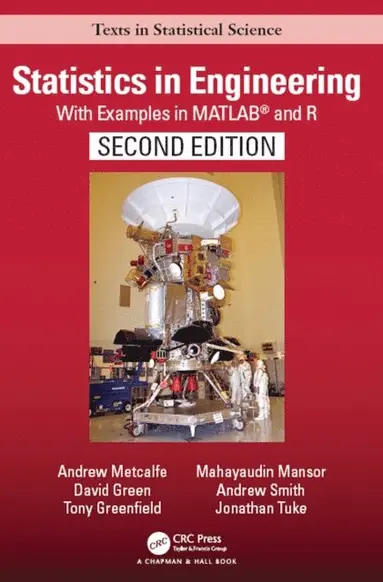
Statistics in Engineering
Dubbelkollat idag
Jämför 1 butik
- Bokus, 953 kr, frakt enligt butiken. Till butik (öppnas i ny flik)
I lagerFrakt: se butikenDubbelkollad 04:51
953 kr
Lägst

Priser från butikernas flöden kan ha ändrats: det är priset hos butiken som gäller, så kontrollera det innan du handlar.
Prishistorik
Köp nu eller vänta?
Just nu kostar produkten 953 kr — 79 kr över det lägsta vi sett på 1 månad.
Pris idag
953 kr
- Lägst
- 874 kr
- Snitt
- 911 kr
- Högst
- 953 kr
| 2026-09-15 | 874 kr · Lägst hos Bokus |
|---|---|
| 2026-10-10 | 953 kr · Lägst hos Bokus |
Om produkten
Statistics in Engineering
Läs merLäs mindre
Engineers are expected to design structures and machines that can operate in challenging and volatile environments, while allowing for variation in materials and noise in measurements and signals. Statistics in Engineering, Second Edition: With Examples in MATLAB and R covers the fundamentals of probability and statistics and explains how to use these basic techniques to estimate and model random variation in the context of engineering analysis and design in all types of environments.The first eight chapters cover probability and probability distributions, graphical displays of data and descriptive statistics, combinations of random variables and propagation of error, statistical inference, bivariate distributions and correlation, linear regression on a single predictor variable, and the measurement error model. This leads to chapters including multiple regression; comparisons of several means and split-plot designs together with analysis of variance; probability models; and sampling strategies. Distinctive features include: All examples based on work in industry, consulting to industry, and research for industry. Examples and case studies include all engineering disciplines. Emphasis on probabilistic modeling including decision trees, Markov chains and processes, and structure functions. Intuitive explanations are followed by succinct mathematical justifications. Emphasis on random number generation that is used for stochastic simulations of engineering systems, demonstration of key concepts, and implementation of bootstrap methods for inference. Use of MATLAB and the open source software R, both of which have an extensive range of statistical functions for standard analyses and also enable programing of specific applications. Use of multiple regression for times series models and analysis of factorial and central composite designs. Inclusion of topics such as Weibull analysis of failure times and split-plot designs that are commonly used in industry but are not usually included in introductory textbooks. Experiments designed to show fundamental concepts that have been tested with large classes working in small groups. Website with additional materials that is regularly updated.