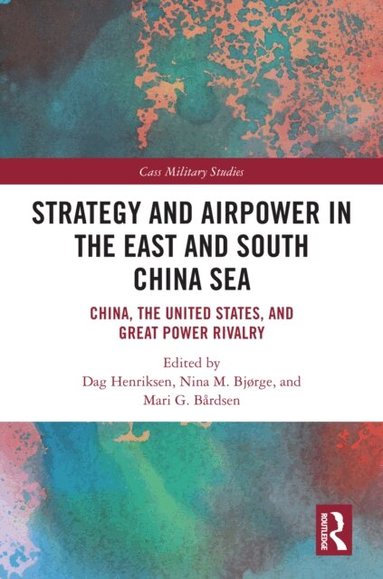
Strategy and Airpower in the East and South China Sea
Dubbelkollade priser
Jämför 1 butik
- Bokus, 831 kr, frakt enligt butiken. Till butik (öppnas i ny flik)
I lagerFrakt: se butikenDubbelkollad 19 okt. 23:51
831 kr
Lägst

Priser från butikernas flöden kan ha ändrats: det är priset hos butiken som gäller, så kontrollera det innan du handlar.
Prishistorik
Köp nu eller vänta?
Just nu kostar produkten 831 kr — 171 kr över det lägsta vi sett på 2 veckor.
Under den tiden har det oftast legat runt 660–830 kr.
Pris idag
831 kr
- Lägst
- 660 kr
- Snitt
- 713 kr
- Högst
- 831 kr
| 2026-09-30 | 660 kr · Lägst hos Bokus |
|---|---|
| 2026-10-12 | 674 kr · Lägst hos Bokus |
| 2026-10-14 | 831 kr · Lägst hos Bokus |
Om produkten
Strategy and Airpower in the East and South China Sea
Läs merLäs mindre
This book examines the role of airpower in the great power rivalry between the United States (US) and the People's Republic of China (PRC) in the East and South China Sea over Taiwan.While the volume emphasizes the role of the US and the PRC, it also looks at the other regional powers with significant airpower capabilities. By including key actors heavily invested in the regional dynamics between the two great powers, this book offers new research on how each actor views the use of airpower to enhance its regional political, military strategic, and operational leverage. The first two parts of the book focus on the PRC and the US, with each part considering (i) their grand strategy in the region, (ii) their military strategy to handle a future conflict over Taiwan, (iii) the role of airpower to this end, and finally (iv) their approach to Multi-Domain Operations or Joint All-Domain Operations. The third part looks at the most dominant regional powers with significant airpower capabilities: Taiwan, Japan, South Korea, and Australia. Finally, the fourth part examines influential alliances in the region: first the relation between Russia, China, and North Korea (DPRK); then NATO and finally The Quad, including Australia, India, Japan, and the US. The volume will help readers better understand the complex and dynamic strategic and military context of this region, and how airpower can be used to enhance the political, military strategic and operational leverage of the various actors in the East and South China Sea.This book will be of much interest to students of strategic studies, air power, Asian politics, and International Relations.