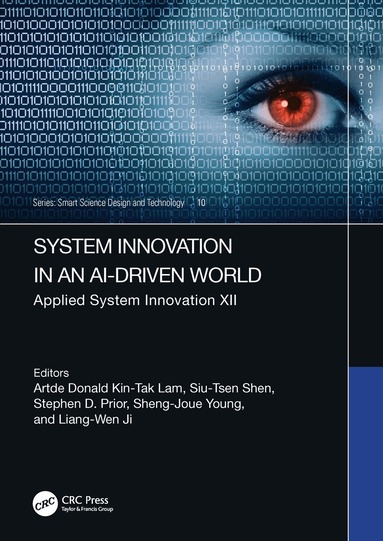
System Innovation in an AI-Driven World
2 468 krhos Bokus · exkl. frakt
741 kr skillnad mellan billigaste och dyraste butik i lager
Dubbelkollat idag
Jämför 2 butiker
- Bokus, 2 468 kr, frakt enligt butiken. Till butik (öppnas i ny flik)
I lagerFrakt: se butikenDubbelkollad 01:51
2 468 kr
Lägst
- Akademibokhandeln, 3 209 kr, frakt enligt butiken. Till butik (öppnas i ny flik)
I lagerFrakt: se butikenDubbelkollad 01:53
3 209 kr

Priser från butikernas flöden kan ha ändrats: det är priset hos butiken som gäller, så kontrollera det innan du handlar.
Prishistorik
Köp nu eller vänta?
Pris idag
2 468 kr
- Lägst
- 2 468 kr
- Snitt
- 2 616 kr
- Högst
- 3 209 kr
| 2026-10-13 | 3 209 kr · Lägst hos Akademibokhandeln |
|---|---|
| 2026-10-14 | 2 468 kr · Lägst hos Bokus |
Om produkten
System Innovation in an AI-Driven World
Läs merLäs mindre
As Artificial Intelligence fundamentally restructures contemporary socio-technical infrastructure, reductive technological paradigms fail to capture emerging institutional complexities. System Innovation in an AI-Driven World establishes a rigorous theoretical framework for transitioning from discrete algorithmic deployment to comprehensive systemic transformation. This volume equips scholars and strategic architects with the epistemological and methodological tools required to analyze, model, and govern complex socio-technical transitions under the influence of pervasive automation.The monograph interrogates the dialectical relationship between advanced computational architectures-specifically deep neural networks, autonomous multi-agent systems, and predictive modeling-and legacy institutional frameworks. Utilizing cross-disciplinary case studies from cyber-physical systems, public health logistics, and decentralized socio-ecological regimes, the text explicates the mechanics of systemic innovation within volatile technological landscapes. The foundational findings indicate that optimal AI integration is not a function of raw algorithmic efficacy; rather, it depends on systemic absorptive capacity, adaptive regulatory polycentricity, and dynamic feedback integration. The research offers structural typologies for mapping non-linear systemic feedback loops, mitigating algorithmic opacity, and synthesizing human-machine governance frameworks. Consequently, the volume demonstrates that sustainable institutional efficacy resides in embedding computational intelligence within fundamentally reconceptualized, non-linear system architectures.This volume is explicitly designed for academic researchers, systems theorists, computational sociologists, and advanced policymakers. It constitutes an indispensable resource for graduate-level seminars and senior scholars investigating the intersection of technology policy, complex adaptive systems, and institutional design amid the contemporary digital transition.