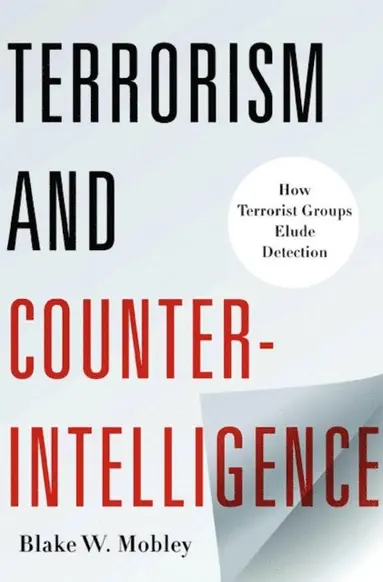
Terrorism and Counterintelligence
Dubbelkollat idag
Jämför 1 butik
- Bokus, 795 kr, frakt enligt butiken. Till butik (öppnas i ny flik)
I lagerFrakt: se butikenDubbelkollad 04:51
795 kr
Lägst

Priser från butikernas flöden kan ha ändrats: det är priset hos butiken som gäller, så kontrollera det innan du handlar.
Prishistorik
Köp nu eller vänta?
Just nu kostar produkten 795 kr — 25 kr över det lägsta vi sett på 1 månad.
Pris idag
795 kr
- Lägst
- 770 kr
- Snitt
- 782 kr
- Högst
- 795 kr
| 2026-09-15 | 770 kr · Lägst hos Bokus |
|---|---|
| 2026-10-10 | 795 kr · Lägst hos Bokus |
Om produkten
Terrorism and Counterintelligence
Läs merLäs mindre
Protecting information, identifying undercover agents, and operating clandestinely-efforts known as counterintelligence-are the primary objectives of terrorist groups evading detection by intelligence and law enforcement officials. Some strategies work well, some fail, and those tasked with tracking these groups are deeply invested in the difference.Discussing the challenges terrorist groups face as they multiply and plot international attacks, while at the same time providing a framework for decoding the strengths and weaknesses of their counterintelligence, Blake W. Mobley provides an indispensable text for the intelligence, military, homeland security, and law enforcement fields. He outlines concrete steps for improving the monitoring, disruption, and elimination of terrorist cells, primarily by exploiting their mistakes in counterintelligence. A key component of Mobley''s approach is to identify and keep close watch on areas that often exhibit weakness. While some counterintelligence pathologies occur more frequently among certain terrorist groups, destructive bureaucratic tendencies, such as mistrust and paranoia, pervade all organizations. Through detailed case studies, Mobley shows how to recognize and capitalize on these shortcomings within a group''s organizational structure, popular support, and controlled territory, and he describes the tradeoffs terrorist leaders make to maintain cohesion and power. He ultimately shows that no group can achieve perfect secrecy while functioning effectively and that every adaptation or new advantage supposedly attained by these groups also produces new vulnerabilities.