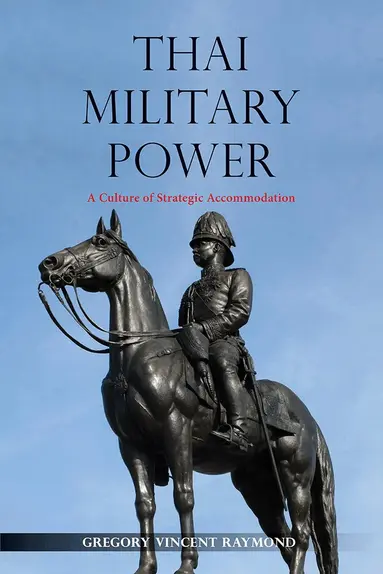
Thai Military Power: A Culture of Strategic Accommodation
- Vikt 0,43 kg
325 krhos Bokus · exkl. frakt
94 kr skillnad mellan billigaste och dyraste butik i lager
Dubbelkollat idag
Jämför 2 butiker
- Bokus, 325 kr, frakt enligt butiken. Till butik (öppnas i ny flik)
I lagerFrakt: se butikenDubbelkollad 15:51
325 kr
Lägst
- Akademibokhandeln, 419 kr, frakt enligt butiken. Till butik (öppnas i ny flik)
I lagerFrakt: se butikenDubbelkollad 15:53
419 kr

Priser från butikernas flöden kan ha ändrats: det är priset hos butiken som gäller, så kontrollera det innan du handlar.
Prishistorik
Köp nu eller vänta?
Just nu kostar produkten 325 kr — 4 kr över det lägsta vi sett på 1 månad.
Under den tiden har det oftast legat runt 320–330 kr.
Pris idag
325 kr
- Lägst
- 321 kr
- Snitt
- 324 kr
- Högst
- 326 kr
| 2026-09-15 | 321 kr · Lägst hos Bokus |
|---|---|
| 2026-09-18 | 323 kr · Lägst hos Bokus |
| 2026-09-20 | 322 kr · Lägst hos Bokus |
| 2026-09-27 | 321 kr · Lägst hos Bokus |
| 2026-09-30 | 322 kr · Lägst hos Bokus |
| 2026-10-02 | 324 kr · Lägst hos Bokus |
| 2026-10-05 | 325 kr · Lägst hos Bokus |
| 2026-10-06 | 326 kr · Lägst hos Bokus |
| 2026-10-11 | 324 kr · Lägst hos Bokus |
| 2026-10-13 | 323 kr · Lägst hos Bokus |
| 2026-10-16 | 325 kr · Lägst hos Bokus |
Om produkten
Thai Military Power: A Culture of Strategic Accommodation
Läs merLäs mindre
Thailand remains important by virtue of its location at the centre of the Asia-Pacific region, an area playing a vital role in world affairs. And yet, although Thailand has a comparatively large population and has powerful military forces performing significant roles in state and society, the country itself is seen as having little military power; it is a minor player. Why is this?Using strategic culture as an analytical framework, this book produces a portrait of the Thai state as an accommodative actor. During the period of Western imperial dominance in Asia, Thailand `bent in the wind' to preserve its independence by a limited trading of territory and sovereignty. This accommodative policy continues to the present day in different forms. A key feature is that military organisational culture reinforces a state ideology of royalist nationalism that in turn reinforces the national strategic culture.Significant here is internal political acceptance of not just military domination in civil-military relations but also of the Thai military's limitations in state-on-state combat. The author finds such `underbalancing' - not responding to threat, or responding to it inadequately - elsewhere in Southeast Asia, too, especially in Indonesia. Although ASEAN's two largest economies, and despite the challenges presented by a rising China, neither country is acting to significantly build alliances or rapidly strengthen their military forces. Pointing as well to other Southeast Asian nations with weak civil control of their militaries, including Myanmar, the Philippines and Cambodia, the book sets out a case that the interplay of civil-military relations and militaryorganisational culture retards the development of strong external defence postures.
Specifikationer
Fakta
- Vikt
- 0,43 kg
- GTIN
- 09788776942403
Uppgifter från tillverkare och butiker.