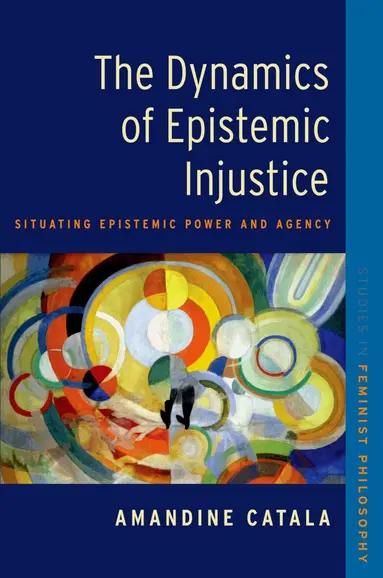
The Dynamics of Epistemic Injustice
- Vikt 0,51 kg
413 krhos Bokus · exkl. frakt
126 kr skillnad mellan billigaste och dyraste butik i lager
Dubbelkollade priser
Jämför 4 butiker
- Bokus, 413 kr, frakt enligt butiken. Till butik (öppnas i ny flik)
I lagerFrakt: se butikenDubbelkollad 05:51
413 kr
Lägst
- Akademibokhandeln, 539 kr, frakt enligt butiken. Till butik (öppnas i ny flik)
I lagerFrakt: se butikenDubbelkollad 05:53
539 kr
- Buyersclub, 369 kr, frakt enligt butiken. Till butik (öppnas i ny flik)
Slut i lagerFrakt: se butikenDubbelkollad 05:34
369 kr
- Adlibris, 401 kr, frakt enligt butiken. Till butik (öppnas i ny flik)
Slut i lagerFrakt: se butikenDubbelkollad 27 okt. 09:10
401 kr



Priser från butikernas flöden kan ha ändrats: det är priset hos butiken som gäller, så kontrollera det innan du handlar.
Prishistorik
Köp nu eller vänta?
Just nu kostar produkten 413 kr — 73 kr över det lägsta vi sett på 1 månad.
Under den tiden har det oftast legat runt 370–400 kr.
Pris idag
413 kr
- Lägst
- 340 kr
- Snitt
- 383 kr
- Högst
- 413 kr
| 2026-09-15 | 340 kr · Lägst hos Adlibris |
|---|---|
| 2026-09-16 | 344 kr · Lägst hos Adlibris |
| 2026-09-24 | 401 kr · Lägst hos Adlibris |
| 2026-10-03 | 404 kr · Lägst hos Bokus |
| 2026-10-05 | 401 kr · Lägst hos Adlibris |
| 2026-10-06 | 369 kr · Lägst hos Buyersclub |
| 2026-10-21 | 413 kr · Lägst hos Bokus |
Om produkten
The Dynamics of Epistemic Injustice
Läs merLäs mindre
Epistemic injustice refers to the injustice that a person suffers specifically in their capacity as a knower--i.e., as someone who produces, conveys, or uses knowledge. Epistemic injustice occurs every day when members of non-dominant groups are not included or taken seriously in conversations or social representations due to individual or societal biases.Epistemic injustice is inherently connected to epistemic power and epistemic agency: understanding and addressing epistemic injustice allows us to better understand and address epistemic power and agency, and vice versa. Yet, despite vast and rich discussions of epistemic injustice, which often invoke the notions of epistemic power and epistemic agency, both notions remain undertheorized and hence largely elusive. Amandine Catala offers a systematic account of epistemic power and agency by turning to the dynamics of epistemic injustice -- that is, the many forms epistemic injustice can take, the different sites and mechanisms through which it operates, and the various transformations consequently required to cultivate greater epistemic justice.Adopting standpoint theory as both a theoretical and a methodological framework, Catala considers several pressing social questions, such as deliberative impasses in divided societies, colonial memory, academic migration, the underrepresentation of members of non-dominant groups in certain fields, the marginalization of minoritized minds such as intellectually disabled people, and the underdiagnosing of autistic women. By analyzing these social questions through the lens of the dynamics of epistemic injustice, this book makes two main contributions: it develops a systematic account of epistemic power and agency that highlights the interaction between individual and structural factors, and it offers a pluralist account of epistemic injustice and agency that reveals their non-propositional and non-verbal dimensions.
Specifikationer
Fakta
- Vikt
- 0,51 kg
- GTIN
- 09780197776322
Uppgifter från tillverkare och butiker.