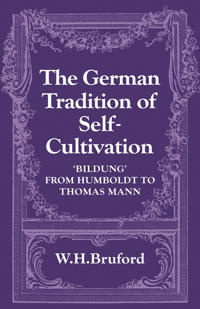
The German Tradition of Self-Cultivation
Dubbelkollade priser
Jämför 1 butik
- Adlibris, 567 kr, frakt enligt butiken. Till butik (öppnas i ny flik)
Slut i lagerFrakt: se butikenDubbelkollad 27 okt. 09:10
567 kr

Priser från butikernas flöden kan ha ändrats: det är priset hos butiken som gäller, så kontrollera det innan du handlar.
Prishistorik
Köp nu eller vänta?
- Lägst
- 567 kr
- Snitt
- 567 kr
- Högst
- 567 kr
| 2026-09-15 | 567 kr · Lägst hos Adlibris |
|---|---|
| 2026-10-04 | Ingen butik hade produkten i lager |
| 2026-10-08 | 567 kr · Lägst hos Adlibris |
| 2026-10-22 | Ingen butik hade produkten i lager |
Om produkten
The German Tradition of Self-Cultivation
Läs merLäs mindre
In a lecture in 1923, Thomas Mann said that the ordinary middle-class German had never considered culture to include an interest in politics, and still did not do so. The idea of the true freedom which comes to the man who lives as much as possible in the invisible world of culture and accepts as a kind of fate his social, political and material circumstances was indeed at the heart of the German idealism of Goethe's day, and unworldliness went along with very great achievements in literature, scholarship and philosophy. Bildung, self-cultivation, came to be as natural a requirement of educated, middle-class life as sport was in England. In this book, originally published in 1975, Professor Bruford provides a sequel to Culture and Society in Classical Weimar 1775–1806 and shows how the ideal of self-cultivation entered into the thought of a number of highly individual German philosophers, theologians, poets and novelists, each in his own corner of the rapidly changing world of the