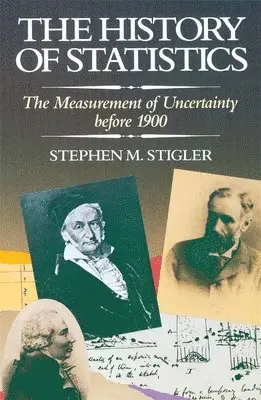
History of Statistics
- Vikt 0,64 kg
418 krhos Bokus · exkl. frakt
121 kr skillnad mellan billigaste och dyraste butik i lager
Dubbelkollade priser
Jämför 4 butiker
- Bokus, 418 kr, frakt enligt butiken. Till butik (öppnas i ny flik)
I lagerFrakt: se butikenDubbelkollad 05:51
418 kr
Lägst
- Buyersclub, 429 kr, frakt enligt butiken. Till butik (öppnas i ny flik)
I lagerFrakt: se butikenDubbelkollad 22 okt. 06:26
429 kr
- Akademibokhandeln, 539 kr, frakt enligt butiken. Till butik (öppnas i ny flik)
I lagerFrakt: se butikenDubbelkollad 05:53
539 kr
- Adlibris, 483 kr, frakt enligt butiken. Till butik (öppnas i ny flik)
Slut i lagerFrakt: se butikenDubbelkollad 05:10
483 kr



Priser från butikernas flöden kan ha ändrats: det är priset hos butiken som gäller, så kontrollera det innan du handlar.
Prishistorik
Köp nu eller vänta?
Just nu kostar produkten 418 kr — 8 kr över det lägsta vi sett på 1 månad.
Under den tiden har det oftast legat runt 410–420 kr.
Pris idag
418 kr
- Lägst
- 410 kr
- Snitt
- 416 kr
- Högst
- 429 kr
| 2026-09-09 | 429 kr · Lägst hos Buyersclub |
|---|---|
| 2026-09-15 | 415 kr · Lägst hos Bokus |
| 2026-09-17 | 412 kr · Lägst hos Bokus |
| 2026-09-20 | 411 kr · Lägst hos Bokus |
| 2026-09-25 | 410 kr · Lägst hos Bokus |
| 2026-10-02 | 413 kr · Lägst hos Bokus |
| 2026-10-04 | 415 kr · Lägst hos Bokus |
| 2026-10-08 | 419 kr · Lägst hos Bokus |
| 2026-10-09 | 418 kr · Lägst hos Bokus |
| 2026-10-11 | 417 kr · Lägst hos Bokus |
| 2026-10-13 | 416 kr · Lägst hos Bokus |
| 2026-10-16 | 418 kr · Lägst hos Bokus |
| 2026-10-17 | 417 kr · Lägst hos Bokus |
| 2026-10-22 | 416 kr · Lägst hos Bokus |
Om produkten
History of Statistics
Läs merLäs mindre
This magnificent book is the first comprehensive history of statistics from its beginnings around 1700 to its emergence as a distinct and mature discipline around 1900. Stephen M. Stigler shows how statistics arose from the interplay of mathematical concepts and the needs of several applied sciences including astronomy, geodesy, experimental psychology, genetics, and sociology. He addresses many intriguing questions: How did scientists learn to combine measurements made under different conditions? And how were they led to use probability theory to measure the accuracy of the result? Why were statistical methods used successfully in astronomy long before they began to play a significant role in the social sciences? How could the introduction of least squares predate the discovery of regression by more than eighty years? On what grounds can the major works of men such as Bernoulli, De Moivre, Bayes, Quetelet, and Lexis be considered partial failures, while those of Laplace, Galton, Edgeworth, Pearson, and Yule are counted as successes? How did Galton's probability machine (the quincunx) provide him with the key to the major advance of the last half of the nineteenth century?Stigler's emphasis is upon how, when, and where the methods of probability theory were developed for measuring uncertainty in experimental and observational science, for reducing uncertainty, and as a conceptual framework for quantitative studies in the social sciences. He describes with care the scientific context in which the different methods evolved and identifies the problems (conceptual or mathematical) that retarded the growth of mathematical statistics and the conceptual developments that permitted major breakthroughs.Statisticians, historians of science, and social and behavioral scientists will gain from this book a deeper understanding of the use of statistical methods and a better grasp of the promise and limitations of such techniques. The product of ten years of research, The History of Statistics will appeal to all who are interested in the humanistic study of science.
Specifikationer
Fakta
- Vikt
- 0,64 kg
- GTIN
- 09780674403413
Uppgifter från tillverkare och butiker.