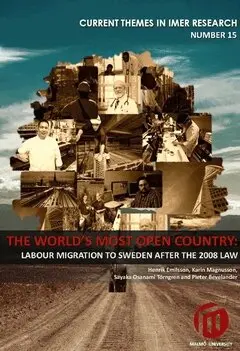
The world's most open country : labour migration to Sweden after the 2008 law
- Vikt 0,25 kg
Dubbelkollat idag
Jämför 2 butiker
- Bokus, 122 kr, frakt enligt butiken. Till butik (öppnas i ny flik)
Slut i lagerFrakt: se butikenDubbelkollad 10:51
122 kr
- Akademibokhandeln, 159 kr, frakt enligt butiken. Till butik (öppnas i ny flik)
Slut i lagerFrakt: se butikenDubbelkollad 11:18
159 kr

Priser från butikernas flöden kan ha ändrats: det är priset hos butiken som gäller, så kontrollera det innan du handlar.
Prishistorik
Köp nu eller vänta?
- Lägst
- 122 kr
- Snitt
- 124 kr
- Högst
- 159 kr
| 2026-09-15 | 122 kr · Lägst hos Bokus |
|---|---|
| 2026-10-28 | 159 kr · Lägst hos Akademibokhandeln |
| 2026-10-31 | Ingen butik hade produkten i lager |
Om produkten
Current themes in IMER research nr 15
Läs merLäs mindre
What happens when a state entrusts the power to select labour migrants to individual employers? This question seems unlikely in a world where countries tend to increase their efforts to control migration flows. When it comes to labour migration, for example, there is a trend towards more selective policies where states try to attract high-skilled migrants while low-skilled migrants are restricted to temporary migration programs with less access to rights (Ruhs 2013, De Somer 2012). In general, there is a trade-off between generous admission policies and the set of rights labour migrants have. The rights are also often very different for lowand high-skilled labour migrants (Ruhs 2013). None of these trends applies to the Swedish case. In fact, the country has done the opposite. The new law on labour migration that came into force on December 15 in 2008 abolished the labour market test and introduced a non-selective demand driven labour migration policy where individual employers were given the power to select migrant workers. Tobias Billström, the Swedish minister of migration, seldom misses a chance to promote its design and present it as a role model for other countries to follow. At the 2013 UN Commission on population and development Billström said that "Sweden now has one of the most flexible and efficient systems for labour migration in the world".In this book we want to make a contribution to the research on labour migration management, while at the same time giving voice to the high-skilled migrants and their experiences. The Swedish case provides a great opportunity to study the effects of a policy change. Firstly, there is a clear policy change in December 15 2008 that affected all kinds of labour migration from outside the EU/EEA. The labour market test was abolished and the policy is now one of the most pure examples of a demand driven labour migration model which is estimated to be one of the world's most open (OECD 2011). Secondly, the Swedish statistical registers allow for a follow-up of the total population of labour migrants, including their position on the labour market.
Specifikationer
Fakta
- Vikt
- 0,25 kg
- GTIN
- 09789171046178
Uppgifter från tillverkare och butiker.