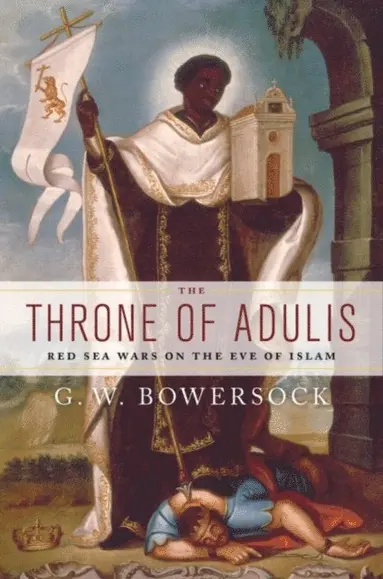
Throne of Adulis
Dubbelkollat idag
Jämför 1 butik
- Bokus, 457 kr, frakt enligt butiken. Till butik (öppnas i ny flik)
I lagerFrakt: se butikenDubbelkollad 22:51
457 kr
Lägst

Priser från butikernas flöden kan ha ändrats: det är priset hos butiken som gäller, så kontrollera det innan du handlar.
Prishistorik
Köp nu eller vänta?
Just nu kostar produkten 457 kr — 155 kr över det lägsta vi sett på 1 månad.
Under den tiden har det oftast legat runt 300–460 kr.
Pris idag
457 kr
- Lägst
- 302 kr
- Snitt
- 409 kr
- Högst
- 457 kr
| 2026-09-15 | 431 kr · Lägst hos Bokus |
|---|---|
| 2026-09-29 | 302 kr · Lägst hos Bokus |
| 2026-10-11 | 457 kr · Lägst hos Bokus |
Om produkten
Throne of Adulis
Läs merLäs mindre
Just prior to the rise of Islam in the sixth century AD, southern Arabia was embroiled in a violent conflict between Christian Ethiopians and Jewish Arabs. Though little known today, this was an international war that involved both the Byzantine Empire, which had established Christian churches in Ethiopia, and the Sasanian Empire in Persia, which supported the Jews in what became a proxy war against its longtime foe Byzantium.Our knowledge of these events derives largely from an inscribed marble throne at the Ethiopian port of Adulis, meticulously described by a sixth-century Christian merchant known as Cosmas Indicopleustes. Using the writings of Cosmas and a wealth of other historical and archaeological evidence from the period, eminent historian G. W. Bowersock carefully reconstructs this fascinating but overlooked chapter in pre-Islamic Arabian history. The flashpoint of the war, Bowersock tells us, occurred when Yusuf, the Jewish king of Himyar, massacred hundreds of Christians living in Najran. The Christian ruler of Ethiopia, Kaleb, urged on by the Byzantine emperor Justin, led a force of 120,000 men across the Red Sea to defeat Yusuf. But when the victorious Kaleb--said to have retired to a monastery-left behind weak leaders in both Ethiopia and Himyar, the Byzantine and Persian empires expanded their activity in the Arabian territory. In the midst of this conflict, a new religion was born, destined to bring a wholly unanticipated resolution to the power struggle in Arabia.The Throne of Adulis vividly recreates the Red Sea world of Late Antiquity, transporting readers back to a remote but pivotal epoch in ancient history, one that sheds light on the collapse of the Persian Empire as well as the rise of Islam.