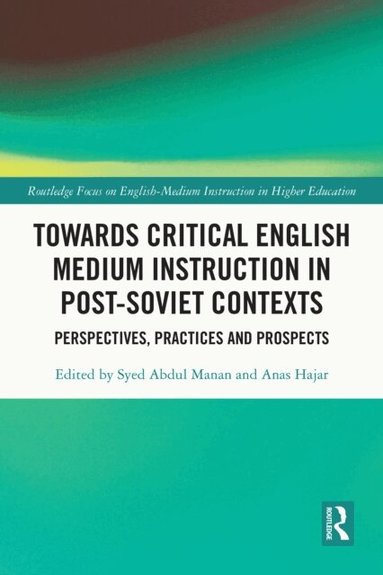
Towards Critical English Medium Instruction in Post-Soviet Contexts
Dubbelkollat idag
Jämför 1 butik
- Bokus, 851 kr, frakt enligt butiken. Till butik (öppnas i ny flik)
I lagerFrakt: se butikenDubbelkollad 09:51
851 kr
Lägst

Priser från butikernas flöden kan ha ändrats: det är priset hos butiken som gäller, så kontrollera det innan du handlar.
Prishistorik
Köp nu eller vänta?
Just nu kostar produkten 851 kr — 18 kr över det lägsta vi sett på 2 veckor.
Pris idag
851 kr
- Lägst
- 833 kr
- Snitt
- 839 kr
- Högst
- 851 kr
| 2026-09-30 | 833 kr · Lägst hos Bokus |
|---|---|
| 2026-10-12 | 851 kr · Lägst hos Bokus |
Om produkten
Towards Critical English Medium Instruction in Post-Soviet Contexts
Läs merLäs mindre
This pioneering volume brings together established and emerging scholars to explore English Medium Instruction (EMI) through a critical lens across post-Soviet regions, including Central Asian republics and countries like Azerbaijan, Georgia, Latvia, Estonia, Ukraine, and Russia.As English rapidly expands within educational spheres across these nations-driven by globalization, neoliberalism, and Englishization, this volume addresses a significant research gap by moving beyond traditional managerial and administrative approaches to EMI. The contributors examine how EMI intersects with five critical dimensions: ideology, policy, identity, social justice, and the politics of English. Rather than focusing solely on technical aspects like language proficiency and teacher training, the volume interrogates how EMI reshapes linguistic hierarchies, influences teacher and learner identities, and potentially perpetuates linguistic imperialism and Eurocentric paradigms. By situating EMI within local sociolinguistic ecologies and cultural contexts, the authors advocate for more equitable, transformative educational practices that acknowledge multilingual repertoires and indigenous knowledge systems. Bringing together empirical data and theoretical analyses of various critical aspects of EMI, the contributors shed light on the nuances, complexities, challenges, and opportunities that these highly diverse multilingual post-Soviet contexts present.Offering frameworks for recontextualizing EMI within Global South epistemologies, this book will be an essential reading for researchers, educators, and policymakers engaged with language policy, internationalization, multilingual education, and decoloniality.