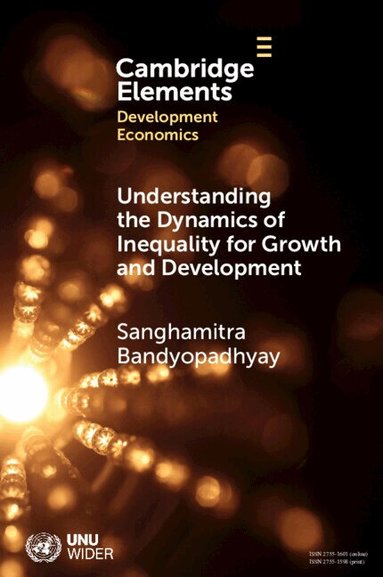
Understanding the Dynamics of Inequality for Growth and Development
291 krhos Bokus · exkl. frakt
88 kr skillnad mellan billigaste och dyraste butik i lager
Dubbelkollat idag
Jämför 2 butiker
- Bokus, 291 kr, frakt enligt butiken. Till butik (öppnas i ny flik)
I lagerFrakt: se butikenDubbelkollad 18:51
291 kr
Lägst
- Akademibokhandeln, 379 kr, frakt enligt butiken. Till butik (öppnas i ny flik)
I lagerFrakt: se butikenDubbelkollad 19:20
379 kr

Priser från butikernas flöden kan ha ändrats: det är priset hos butiken som gäller, så kontrollera det innan du handlar.
Prishistorik
Köp nu eller vänta?
Just nu kostar produkten 291 kr — 7 kr över det lägsta vi sett på 2 veckor.
Under den tiden har det oftast legat runt 280–290 kr.
Pris idag
291 kr
- Lägst
- 284 kr
- Snitt
- 293 kr
- Högst
- 369 kr
| 2026-10-01 | 369 kr · Lägst hos Akademibokhandeln |
|---|---|
| 2026-10-02 | 284 kr · Lägst hos Bokus |
| 2026-10-08 | 291 kr · Lägst hos Bokus |
Om produkten
Understanding the Dynamics of Inequality for Growth and Development
Läs merLäs mindre
Inequality and its evolution over time are increasingly important subjects within the social sciences, particularly in the field of political economy. This Element identifies for the first time which inequality measures are best suited to capture the dynamics of inequality. The author generates a dataset of twelve types of inequality measures for 108 years across 34 countries using mortality distributions. When modelling inequality as a fractionally integrated process and using a Vector Autoregression approach, they find that mean-independent inequality measures are more suited to dynamic studies. In contrast, however, mean-dependent measures are unsuitable for dynamic studies. They suggest that no inequality measure should be used for dynamic purposes without rigorously testing its suitability. Tests of temporal normality and volatility serve as excellent "marker" tests of whether a chosen inequality measure is suitable for dynamic contexts. This title is also available as Open Access on Cambridge Core.