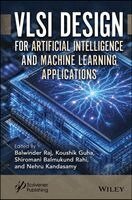
VLSI Design for Artificial Intelligence and Machine Learning Applications
2 365 krhos Bokus · exkl. frakt
704 kr skillnad mellan billigaste och dyraste butik i lager
Dubbelkollat idag
Jämför 2 butiker
- Bokus, 2 365 kr, frakt enligt butiken. Till butik (öppnas i ny flik)
I lagerFrakt: se butikenDubbelkollad 19:51
2 365 kr
Lägst
- Akademibokhandeln, 3 069 kr, frakt enligt butiken. Till butik (öppnas i ny flik)
I lagerFrakt: se butikenDubbelkollad 19:53
3 069 kr

Priser från butikernas flöden kan ha ändrats: det är priset hos butiken som gäller, så kontrollera det innan du handlar.
Prishistorik
Köp nu eller vänta?
Pris idag
2 365 kr
- Lägst
- 2 365 kr
- Snitt
- 2 603 kr
- Högst
- 3 079 kr
| 2026-10-14 | 3 079 kr · Lägst hos Akademibokhandeln |
|---|---|
| 2026-10-15 | 2 365 kr · Lägst hos Bokus |
Om produkten
VLSI Design for Artificial Intelligence and Machine Learning Applications
Läs merLäs mindre
Unlock the next generation of AI chip design with this comprehensive guide to overcoming VLSI challenges, combining state-of-the-art nanomaterials, semiconductor modeling, and low-power circuit design into an essential roadmap for researchers and engineers. Very large-scale integration (VLSI) is the interdisciplinary science of utilizing advanced semiconductor technology to create various functions of a computer system. By combining VLSI technology, a very powerful computer architecture is possible to overcome the problems at different design stages. AI techniques such as knowledge-based and expert systems first define the problem and then choose the best solution from a range of possible approaches. This book comprehensively covers nanomaterials, semiconductor devices, and modeling and simulation techniques used to address the challenges of low-power VLSI chip design. It explores process variability, device sizing, power supply scaling, conventional and emerging materials, leakage mitigation techniques, and critical design tradeoffs. The book presents state-of-the-art research in nanomaterials and semiconductor technologies alongside practical design considerations for low-power VLSI circuits, making it an essential resource for scientists, researchers, and postgraduate students interested in AI hardware, semiconductor devices, modeling, and simulation.