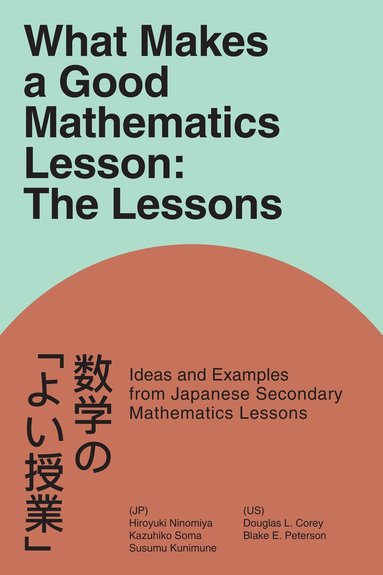
What Makes a Good Mathematics Lesson
2 060 krhos Bokus · exkl. frakt
619 kr skillnad mellan billigaste och dyraste butik i lager
Dubbelkollat idag
Jämför 2 butiker
- Bokus, 2 060 kr, frakt enligt butiken. Till butik (öppnas i ny flik)
I lagerFrakt: se butikenDubbelkollad 22:51
2 060 kr
Lägst
- Akademibokhandeln, 2 679 kr, frakt enligt butiken. Till butik (öppnas i ny flik)
I lagerFrakt: se butikenDubbelkollad 22:53
2 679 kr

Priser från butikernas flöden kan ha ändrats: det är priset hos butiken som gäller, så kontrollera det innan du handlar.
Prishistorik
Köp nu eller vänta?
Pris idag
2 060 kr
- Lägst
- 2 060 kr
- Snitt
- 2 137 kr
- Högst
- 2 679 kr
| 2026-10-09 | 2 679 kr · Lägst hos Akademibokhandeln |
|---|---|
| 2026-10-10 | 2 060 kr · Lägst hos Bokus |
Om produkten
What Makes a Good Mathematics Lesson
Läs merLäs mindre
Have you ever wondered What Makes a Good Mathematics Lesson?For many years, this has been a topic of conversation between American mathematics educators Douglas Corey and Blake Peterson, and their Japanese colleagues Hiroyuki Ninomiya, Kazuhiko Soma, and Susumu Kunimune. This conversation led these Japanese mathematics educators to articulate "key considerations" that should be addressed when preparing a good mathematics lesson and the "criteria" that can be used as guidelines when reflecting on the quality of a lesson after it has been taught.The three considerations are:Make the Goal of the Lesson ClearThoughtfully Decide on the Problem and its PresentationPlan Ways to Incorporate Students' IdeasAnd the questions corresponding to the criteria are:Were Students Proactively Engaged and Did They Continue to Think for Themselves?Were the Objectives Appropriately Set and Achieved?In What Makes a Good Mathematics Lesson: The Lessons, 27 Japanese middle school teachers describe lessons in which they implemented the key considerations and two criteria. At the end of this book, four US teachers each describe their adaptation of one of these 27 lessons in their classroom and contextualize the key considerations and criteria for their respective situations.In What Makes a Good Mathematics Lesson: The Theory, the Japanese authors discuss the conceptual underpinning of the three key considerations and two criteria. The Theory also includes an introductory chapter written by the American mathematics educators contextualizing Japanese mathematics education for an English-speaking audience.