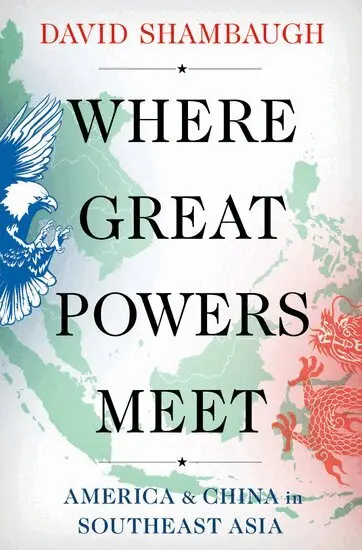
Where Great Powers Meet
- Vikt 0,53 kg
313 krhos Bokus · exkl. frakt
96 kr skillnad mellan billigaste och dyraste butik i lager
Dubbelkollat idag
Jämför 2 butiker
- Bokus, 313 kr, frakt enligt butiken. Till butik (öppnas i ny flik)
I lagerFrakt: se butikenDubbelkollad 06:51
313 kr
Lägst
- Akademibokhandeln, 409 kr, frakt enligt butiken. Till butik (öppnas i ny flik)
I lagerFrakt: se butikenDubbelkollad 06:53
409 kr

Priser från butikernas flöden kan ha ändrats: det är priset hos butiken som gäller, så kontrollera det innan du handlar.
Prishistorik
Köp nu eller vänta?
Just nu kostar produkten 313 kr — 10 kr över det lägsta vi sett på 1 månad.
Pris idag
313 kr
- Lägst
- 303 kr
- Snitt
- 309 kr
- Högst
- 313 kr
| 2026-09-15 | 303 kr · Lägst hos Bokus |
|---|---|
| 2026-10-05 | 313 kr · Lägst hos Bokus |
Om produkten
Where Great Powers Meet
Läs merLäs mindre
After the end of the Cold War, it seemed as if Southeast Asia would remain a geopolitically stable region within the American-led order for the foreseeable future. In the last two decades, however, the re-emergence of China as a major great power has called into question the geopolitical future of the region and raised the specter of renewed great power competition. As the eminent China scholar David Shambaugh explains in Where Great Powers Meet, the United States and China are engaged in a broad-gauged and global competition for power. While this competition ranges across the entire world, it is centered in Asia. In this book, Shambaugh focuses on the critical sub-region of Southeast Asia. The United States and China constantly vie for position and influence across this enormously significant area--and the outcome of this contest will do much to determine whether Asia leaves the American orbit after seven decades and falls into a new Chinese sphere of influence. Just as importantly, to the extent that there is a global "power transition" occurring from the US to China, the fate of Southeast Asia will be a good indicator. Presently, both powers bring important assets to bear in their competition. The United States continues to possess a depth and breadth of security ties, soft power, and direct investment across the region that empirically outweigh China's. For its part, China has more diplomatic influence, much greater trade, and geographic proximity. In assessing the likelihood of a regional power transition, Shambaugh examines how ASEAN (the Association of Southeast Asian Nations) and its member states maneuver and the degree to which they align with one or the other power.
Specifikationer
Fakta
- Vikt
- 0,53 kg
- GTIN
- 09780197667347
Uppgifter från tillverkare och butiker.