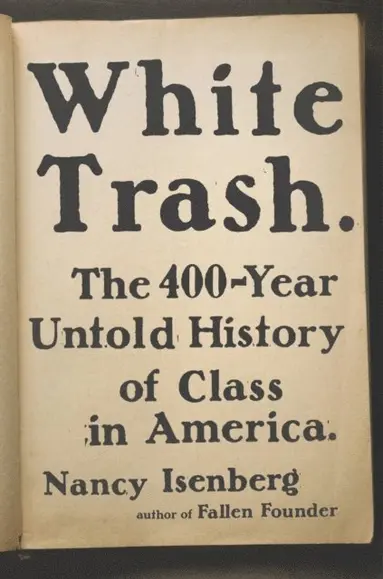
White Trash
Dubbelkollat idag
Jämför 1 butik
- Bokus, 158 kr, frakt enligt butiken. Till butik (öppnas i ny flik)
I lagerFrakt: se butikenDubbelkollad 02:51
158 kr
Lägst

Priser från butikernas flöden kan ha ändrats: det är priset hos butiken som gäller, så kontrollera det innan du handlar.
Prishistorik
Köp nu eller vänta?
Just nu kostar produkten 158 kr — 16 kr över det lägsta vi sett på 1 månad.
Pris idag
158 kr
- Lägst
- 142 kr
- Snitt
- 155 kr
- Högst
- 158 kr
| 2026-09-15 | 142 kr · Lägst hos Bokus |
|---|---|
| 2026-09-25 | 158 kr · Lägst hos Bokus |
Om produkten
White Trash
Läs merLäs mindre
The New York Times bestseller A New York Times Notable and Critics' Top Book of 2016Longlisted for the PEN/John Kenneth Galbraith Award for NonfictionOne of NPR''s 10 Best Books Of 2016 Faced Tough Topics Head OnNPR''s Book Concierge Guide To 2016's Great ReadsSan Francisco Chronicle''s Best of 2016: 100 recommended booksA Washington Post Notable Nonfiction Book of 2016Globe & Mail 100 Best of 2016"Formidable and truth-dealing . . . necessary." -The New York Times"This eye-opening investigation into our country's entrenched social hierarchy is acutely relevant." -O Magazine In her groundbreaking bestselling history of the class system in America, Nancy Isenberg upends history as we know it by taking on our comforting myths about equality and uncovering the crucial legacy of the ever-present, always embarrassing-if occasionally entertaining-poor white trash. "When you turn an election into a three-ring circus, there's always a chance that the dancing bear will win," says Isenberg of the political climate surrounding Sarah Palin. And we recognize how right she is today. Yet the voters who boosted Trump all the way to the White House have been a permanent part of our American fabric, argues Isenberg. The wretched and landless poor have existed from the time of the earliest British colonial settlement to today''s hillbillies. They were alternately known as "waste people," "offals," "rubbish," "lazy lubbers," and "crackers." By the 1850s, the downtrodden included so-called "clay eaters" and "sandhillers," known for prematurely aged children distinguished by their yellowish skin, ragged clothing, and listless minds. Surveying political rhetoric and policy, popular literature and scientific theories over four hundred years, Isenberg upends assumptions about America's supposedly class-free society--where liberty and hard work were meant to ensure real social mobility. Poor whites were central to the rise of the Republican Party in the early nineteenth century, and the Civil War itself was fought over class issues nearly as much as it was fought over slavery. Reconstruction pitted poor white trash against newly freed slaves, which factored in the rise of eugenics--a widely popular movement embraced by Theodore Roosevelt that targeted poor whites for sterilization. These poor were at the heart of New Deal reforms and LBJ's Great Society; they haunt us in reality TV shows like Here Comes Honey Boo Boo and Duck Dynasty. Marginalized as a class, white trash have always been at or near the center of major political debates over the character of the American identity. We acknowledge racial injustice as an ugly stain on our nation's history. With Isenberg's landmark book, we will have to face the truth about the enduring, malevolent nature of class as well.