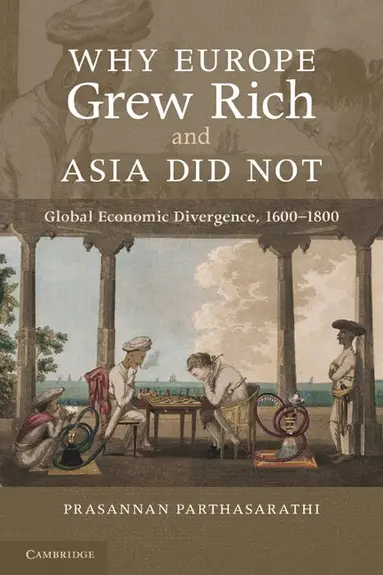
Why Europe Grew Rich and Asia Did Not
- Vikt 0,61 kg
349 krhos Akademibokhandeln · exkl. frakt
153 kr skillnad mellan billigaste och dyraste butik i lager
Dubbelkollade priser
Jämför 3 butiker
- Akademibokhandeln, 349 kr, frakt enligt butiken. Till butik (öppnas i ny flik)
I lagerFrakt: se butikenDubbelkollad 08:53
349 kr
Lägst
- Bokus, 502 kr, frakt enligt butiken. Till butik (öppnas i ny flik)
I lagerFrakt: se butikenDubbelkollad 08:51
502 kr
- Adlibris, 488 kr, frakt enligt butiken. Till butik (öppnas i ny flik)
Slut i lagerFrakt: se butikenDubbelkollad 27 okt. 09:10
488 kr


Priser från butikernas flöden kan ha ändrats: det är priset hos butiken som gäller, så kontrollera det innan du handlar.
Om produkten
Why Europe Grew Rich and Asia Did Not
Läs merLäs mindre
Why Europe Grew Rich and Asia Did Not provides a striking new answer to the classic question of why Europe industrialised from the late eighteenth century and Asia did not. Drawing significantly from the case of India, Prasannan Parthasarathi shows that in the seventeenth and eighteenth centuries the advanced regions of Europe and Asia were more alike than different, both characterized by sophisticated and growing economies. Their subsequent divergence can be attributed to different competitive and ecological pressures that in turn produced varied state policies and economic outcomes. This account breaks with conventional views, which hold that divergence occurred because Europe possessed superior markets, rationality, science or institutions. It offers instead a groundbreaking rereading of global economic development that ranges from India, Japan and China to Britain, France and the Ottoman Empire and from the textile and coal industries to the roles of science, technology and the state.
Specifikationer
Fakta
- Vikt
- 0,61 kg
- GTIN
- 09780521168243
Uppgifter från tillverkare och butiker.