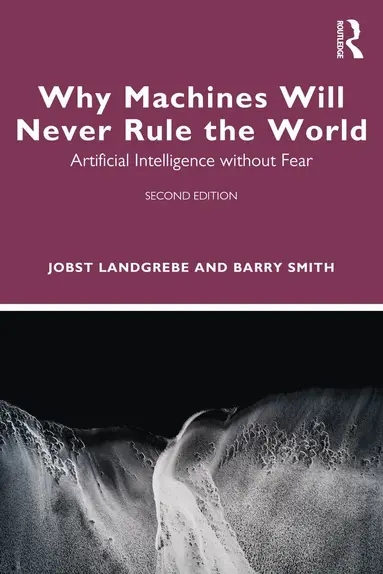
Why Machines Will Never Rule the World
- Vikt 0,6 kg
645 krhos Bokus · exkl. frakt
194 kr skillnad mellan billigaste och dyraste butik i lager
Dubbelkollade priser
Jämför 3 butiker
- Bokus, 645 kr, frakt enligt butiken. Till butik (öppnas i ny flik)
I lagerFrakt: se butikenDubbelkollad 06:51
645 kr
Lägst
- Akademibokhandeln, 839 kr, frakt enligt butiken. Till butik (öppnas i ny flik)
I lagerFrakt: se butikenDubbelkollad 06:53
839 kr
- Adlibris, 643 kr, frakt enligt butiken. Till butik (öppnas i ny flik)
Slut i lagerFrakt: se butikenDubbelkollad 27 okt. 09:10
643 kr


Priser från butikernas flöden kan ha ändrats: det är priset hos butiken som gäller, så kontrollera det innan du handlar.
Prishistorik
Köp nu eller vänta?
Just nu kostar produkten 645 kr — 38 kr över det lägsta vi sett på 1 månad.
Under den tiden har det oftast legat runt 610–640 kr.
Pris idag
645 kr
- Lägst
- 607 kr
- Snitt
- 635 kr
- Högst
- 651 kr
| 2026-09-15 | 635 kr · Lägst hos Bokus |
|---|---|
| 2026-09-18 | 639 kr · Lägst hos Bokus |
| 2026-09-19 | 643 kr · Lägst hos Bokus |
| 2026-09-28 | 636 kr · Lägst hos Bokus |
| 2026-09-30 | 643 kr · Lägst hos Bokus |
| 2026-10-05 | 607 kr · Lägst hos Bokus |
| 2026-10-11 | 648 kr · Lägst hos Bokus |
| 2026-10-12 | 646 kr · Lägst hos Bokus |
| 2026-10-13 | 643 kr · Lägst hos Bokus |
| 2026-10-19 | 647 kr · Lägst hos Bokus |
| 2026-10-22 | 613 kr · Lägst hos Bokus |
| 2026-10-28 | 651 kr · Lägst hos Bokus |
| 2026-11-01 | 645 kr · Lägst hos Bokus |
Om produkten
Why Machines Will Never Rule the World
Läs merLäs mindre
This is a revised and expanded second edition of Why Machines Will Never Rule the World. Its core argument remains the same: that an artificial intelligence (AI) that could equal or exceed human intelligence - sometimes called 'artificial general intelligence' (AGI) - is for mathematical reasons impossible. It offers two specific reasons for this claim:Human intelligence is a capability of the human brain and central nervous system, which is a complex dynamic systemSystems of this sort cannot be modelled mathematically in a way that allows them to operate inside a computerIn supporting their claim, the authors, Jobst Landgrebe and Barry Smith, marshal evidence from mathematics, physics, computer science, philosophy, linguistics, biology, and anthropology, setting up their book around three central questions: What are the essential marks of human intelligence? What is it that researchers try to do when they attempt to achieve 'Artificial Intelligence' (AI)? And why, after more than 50 years, are our interactions with AI, for example when on the telephone with our bank's computers, still so unsatisfactory?The first edition was published the same week that ChatGPT was unleashed onto the world. This second edition shows how the arguments in the book apply already to Large Language Models such as ChatGPT. This new edition also brings up to date the arguments relating to the limits of AI, showing why AI systems are best viewed as pieces of mathematics, which cannot think, feel, or will. They also demolish the idea that, with the help of AI, we could 'solve physics' in a way that would allow us to create, in the cloud, a perfect simulation of reality in which we could enjoy digital immortality. Such ideas reveal a lack of understanding of physics, mathematics, human biology, and computers.There is still, as the authors demonstrate in an updated final chapter, a great deal that AI can achieve which will benefit humanity. But these benefits will be achieved without the aid of systems that are more powerful than humans, which are as impossible as AI systems that are intrinsically 'evil' or able to 'will' a takeover of human society.Key Changes to the Second EditionShows how the arguments of the first edition apply also to new Large Language ModelsAdds a treatment of human practical intelligence - of knowing how vs. knowing that - a topic that is ignored by the AI communityDemonstrates why 'AI ethics' should be relabelled as 'ethics of human uses of AI'Adds a new chapter showing the essential limitations of physics, providing a thorough grounding for the arguments of the bookDemolishes the idea that we might already be living in a simulation
Specifikationer
Fakta
- Vikt
- 0,6 kg
- GTIN
- 09781032941400
Uppgifter från tillverkare och butiker.