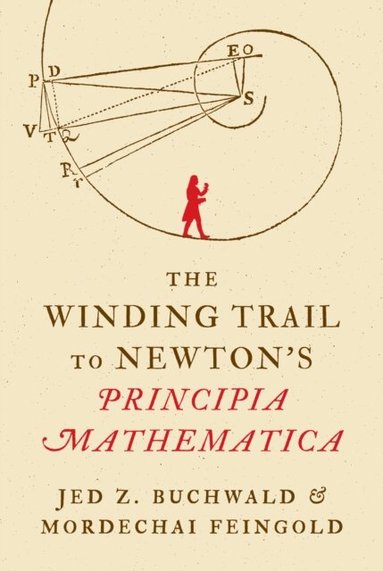
Winding Trail to Newton's Principia Mathematica
Dubbelkollat idag
Jämför 1 butik
- Bokus, 642 kr, frakt enligt butiken. Till butik (öppnas i ny flik)
I lagerFrakt: se butikenDubbelkollad 22:51
642 kr
Lägst

Priser från butikernas flöden kan ha ändrats: det är priset hos butiken som gäller, så kontrollera det innan du handlar.
Prishistorik
Köp nu eller vänta?
Just nu kostar produkten 642 kr — 14 kr över det lägsta vi sett på 2 veckor.
Pris idag
642 kr
- Lägst
- 628 kr
- Snitt
- 638 kr
- Högst
- 642 kr
| 2026-10-01 | 628 kr · Lägst hos Bokus |
|---|---|
| 2026-10-06 | 642 kr · Lägst hos Bokus |
Om produkten
Winding Trail to Newton's Principia Mathematica
Läs merLäs mindre
An intellectual biography of the seventeenth-century masterwork that set down the laws of motion and universal gravitation and ushered in modern physicsLong regarded as one of the most important works in the history of science, Isaac Newton's Principia laid the mathematical foundations of classical mechanics, planetary motion, and the laws of gravity. Jed Buchwald and Mordechai Feingold trace the long, wandering path by which these groundbreaking ideas took shapebeginning with the brilliant insights of a newly minted Cambridge BA and culminating in the publication of Newton's magnum opus in 1687.Drawing on fresh perspectives from Newton's manuscripts and related documents, Buchwald and Feingold situate him firmly within the vibrant scientific milieu of mid-seventeenth-century Cambridge. They explore the interactions with mentors and other contemporaries, emphasizing Newton's distinctive approach to linking motion with the emerging, new mathematics of the era. What develops is a portrait of a restless young scholar, prone to diving deep into a subject only to lose interest, until a letter, a conversation, or a visit would rekindle his interest. For nearly two decades prior to Edmond Halley's pivotal visit in 1684, Newton engaged only sporadically with celestial mechanics. In a narrative of fits and starts, Buchwald and Feingold show how, inspired or assisted by figures such as Isaac Barrow, Robert Hooke, John Flamsteed, and Halley, Newton gradually refined his ideas into what would become one of the most revolutionary books ever written.