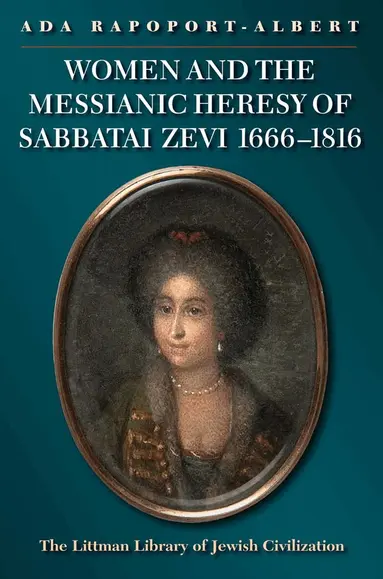
Women and the Messianic Heresy of Sabbatai Zevi, 1666 - 1816
- Vikt 0,56 kg
340 krhos Bokus · exkl. frakt
99 kr skillnad mellan billigaste och dyraste butik i lager
Dubbelkollat idag
Jämför 2 butiker
- Bokus, 340 kr, frakt enligt butiken. Till butik (öppnas i ny flik)
I lagerFrakt: se butikenDubbelkollad 11:51
340 kr
Lägst
- Akademibokhandeln, 439 kr, frakt enligt butiken. Till butik (öppnas i ny flik)
I lagerFrakt: se butikenDubbelkollad 11:53
439 kr

Priser från butikernas flöden kan ha ändrats: det är priset hos butiken som gäller, så kontrollera det innan du handlar.
Prishistorik
Köp nu eller vänta?
Just nu kostar produkten 340 kr — 7 kr över det lägsta vi sett på 1 månad.
Pris idag
340 kr
- Lägst
- 333 kr
- Snitt
- 337 kr
- Högst
- 340 kr
| 2026-09-15 | 333 kr · Lägst hos Bokus |
|---|---|
| 2026-10-05 | 340 kr · Lägst hos Bokus |
Om produkten
Women are conspicuously absent from the Jewish mystical tradition
Läs merLäs mindre
Even if historically some Jewish women may have experienced mystical revelations and led richly productive spiritual lives, the tradition does not preserve any record of their experiences or insights. Only the chance survival of scant evidence suggests that, at various times and places, individual Jewish women did pursue the path of mystical piety or prophetic spirituality, but it appears that they were generally censured, and efforts were made to suppress their activities. This contrasts sharply with the fully acknowledged prominence of women in the mystical traditions of both Christianity and Islam. It is against this background that the mystical messianic movement centred on the personality of Sabbatai Zevi (1626 - 76) stands out as a unique and remarkable exception. Sabbatai Zevi addressed to women a highly original liberationist message, proclaiming that he had come to make them 'as happy as men' by releasing them from the pangs of childbirth and the subjugation to their husbands that were ordained for women as a consequence of the primordial sin. This unprecedented redemptive vision became an integral part of Sabbatian eschatology, which the messianists believed to be unfolding and experienced in the present. Their New Law, superseding the Old with the dawning of the messianic era, overturned the traditional halakhic norms that distinguished and regulated relations between the sexes. This was expressed not only in the outlandish ritual transgression of sexual prohibitions, in which Sabbatian women were notoriously implicated, but also in the apparent adoption of the idea - alien to rabbinic Judaism - that virginity, celibacy, or sexual abstinence were conducive to women's spiritual empowerment. Ada Rapoport-Albert traces the diverse manifestations of this vision in every phase of Sabbatianism and its offshoots. These include the early promotion of women to centre-stage as messianic prophetesses; their independent affiliation with the movement in their own right; their initiation in the esoteric teachings of the kabbalah; and their full incorporation, on a par with men, into the ritual and devotional life of the messianic community. Their investment with authority was such as to elevate the messiah's wife (a figure mostly absent from traditional messianic speculations) to the rank of full messianic consort, sharing in her husband's redemptive mission as well as his divine dimension. By the late eighteenth century, a syncretistic cult had developed that recognized in Eva - the unmarried daughter of Jacob Frank, one of Sabbatai Zevi's apostate messianic successors - an incarnate female aspect of the kabbalistic godhead, worshipped by her father's devotees as 'Holy Virgin' and female messiah. This was the culmination of the Sabbatian endeavour to transcend the traditional gender paradigm that had excluded women from the public arena of Jewish spiritual life.This work is translated by Deborah Greniman.
Specifikationer
Fakta
- Vikt
- 0,56 kg
- GTIN
- 09781906764807
Uppgifter från tillverkare och butiker.